Violent decline

In the first millennia AD, one and ten people died a violent death.

Think about that for a minute. (Everyone that I know that has passed away has mostly died from modern western diseases. Grant it, my family history doesn’t have much of a military background.)

The decline of violent deaths is no accident. The world is just getting safer. One problem is our perception has not changed. We don’t feel safe because our biology is wired to keep us on guard. We have media channels to remind us that the world is falling apart.

Make no mistake, there is plenty of work that must be done. What I am suggesting is thinking about the narrative each of us has about the world and the people around us. If we have no hope that it can change, then what is the point of trying? The fact is, while history can repeat itself it isn’t destined to. It often rhymes but it isn’t predetermined. It may feel broken but it is far from unfixable.

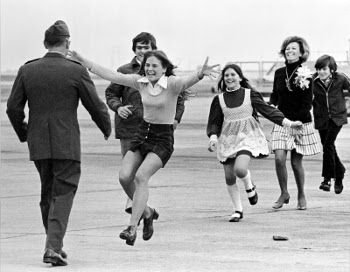
Pulitzer Prize-winning photograph, Burst of Joy, 1973.

Trust the science

There is an enormously better chance than any other time in history for me to see my children and grandchildren to live into adulthood.

Think about that for a minute.

Because during the 19th century, life expectancy was 28.5 to 32 years old. Then the 1900 world expectancy was 31 to 32. In the 1950s, it was 45 to 48. And now, it is 72 to 73.

Incredible.

We have science to thank for this. Science helped us domesticate plants and animals to feed us. Science is the reason why many here in the United States don’t worry about Polio, Tetanus, Measles, Mumps, Rubella, Chicken Pox.

Worldwide it is estimated that 2.9 million cases and 95,000 deaths occur each year around the world because of Cholera. The last outbreak of Cholera in the United States was in 1910. It’s very likely you will never know or meet anyone who will have dealt with such a horrible illness. After all, we are so used to clean drinking water coming right out of the tap–we don’t know any different.

We all benefit from science. I am 35 and would likely be dead by now if I was simply born 200 years ago. Yet, so many of us turn our noses to science today. As of 2007, 216 million Americans are “scientifically illiterate.” Clearly, there is a gap in our knowledge from seeing something work and knowing how things work. We can take Ibprofin and know it makes us feel better, but almost no one understands the chemistry (including myself). That intellectual debt adds up over time. At some point, we throw our hands in the air because we simply don’t understand how things work. So, we turn to others to make sense of things. Rather than change our worldview, we Google to confirm it.

8 out of 10 Americans are dissatisfied with where things are. How much is attributed to not understanding how we got here? How much then are we contributing to making things better for the challenges that lay ahead?
The willing suspension of disbelief

Magic, of course, isn’t real. It requires cooperation from the audience and the magician to suspend critical thinking and skepticism to allow the trick to work. Because if we put on our lab coats, we can dissect and show the audience that the magician didn’t saw anyone in half. It was an illusion.

I love magic. Like most, I want to be entertained. But what we are seeing in our culture today is the continued suspension of critical thinking in exchange for distractions. Most don’t want the responsibility of being in charge, to be accountable, to look foolish when we make mistakes. Most of all we don’t want to be free. We often trade in compliance for safety, reliability, predictability and a pay check. Not everyone. But many will.

Indeed, it’s easy for human beings to be misled and manipulated by others. To be swallowed up by the extraordinary popular delusions and the madness of crowds. Each of us still has the fear of missing out. And we are not above mistakes of the past reguardless of the technology and history available to us.

Illusions are so seductive preciesly because we can suspend our reality. The true believer, in fact, has given their agency away because what someone is promising is better than the options in front of them. Which is how people are able to do unimaginable horrors of the world. “I’m just following orders.”

So the question I have is this: Which beliefs have we been taught are misleeding us? Which ones do you hold dear were handed to us and were never properly scrutinized? After all, we might have trusted these people to show us the “right” path to follow–it’s possible they got it wrong because they trusted someone else that showed them the way things are done.

“I’m not good with technology”

Michael Keaton as Ray Kroc

Michael Keaton plays this brilliant scene of ordering fast food for the first time. He is dumbfounded by the fact that food can appear so quickly and doesn’t understand that you just throw away the wrapper and eat it wherever you want.

In a lot of ways, that is many of us when introduced to new technology. Slack can seem overwhelming when you are using it for the first time. And so is driving automatic transmission if you were used to stick or embracing a new meat substitute.

There is always something new to learn. What brings me solace is the fact that everyone who wants to learn something new has to start from square one. (If you are going to learn to ride a bike, you are going to fall.) The good news is most of the things we learn make us feel incompetent at the beginning around others. Much less harmful than skinning our knees but way harder to commit to since we don’t like to feel exposed.

We really like the feeling of knowing what is going on.

I didn’t notice

Google: How fast is the Earth moving through space?

Answer: “It covers this route at a speed of nearly 30 kilometers per second, or 67,000 miles per hour. In addition, our solar system–Earth and all–whirls around the center of our galaxy at some 220 kilometers per second, or 490,000 miles per hour.” – Scientific America

I didn’t notice going to work this morning that the Earth is traveling those speeds, did you?

What happens if it stopped? Should we call in sick?

There is so much happening all around us that we pick and choose what it is we are noticing. Lingering is the fact that the way things are not the way things will always be.

Leftovers

We don’t appreciate how good things are until they are taken away from us.

Only two hundred years ago, it would be egregious to throw away your food because you weren’t hungry. The refrigerator wasn’t invented until 1899. There was no concept of leftovers prior to this. If you have always grown up with a refrigerator accessible, how would you know any different?

It’s not just food either. If you always turned on the tap and out came clean water, you wouldn’t know this is a huge technological feat.

We’ve come so far and yet so far to go in creating a more just world where everyone can enjoy leftovers. Enjoy what you do have.

What is freedom?

Google defines it as “the power or right to act, speak, or think as one wants without hindrance or restraint.”

I like to add to it:

Any system or person that imposes their authority over someone must be justified. If it can’t be justified then we must find something better to replace it.

I don’t think freedom means the ability to do whatever you want at any time but rather recognizing the rights every human being needs to live (food, water, shelter, etc.) while also extending dignity and opportunity. There’s also the freedom to express thoughts, to worship, to create.

Life is precious. And no person is an island. Freedom is also recognizing the constraints of living in a finite world with finite resources that must be shared.

How will we recognize freedom if we have never tasted it?

The freedom to pick a job or to starve is not a choice.

Start by asking the right questions

The most common error that decision architects make is to optimize something that shouldn’t exist in the first place.

For instance, how long do we keep trying to optimize the automobile before we look at creating a system where more people can simply work from home?

There might not be a suitable answer for the difficult challenges we face. Therefore, we must examine how we got here in the first place and is this the best we can imagine?

The questions themselves are the ones worth thinking about.