The Good Samaritan study

The parable of the Good Samaritan that Jesus taught is about a Jewish man travelling down from Jerusalem to Jericho who was attacked by bandits and left for dead. A Priest and a Levite passed by before a Samaritan stopped to aid this man. (Historically, Samaritans and Jews did not get along.)

In 1973, two physiologists, John Darley and Daniel Batson, took 67 students from the Princeton Theological Seminary to replicate the parable of the Good Samaritan. Half of them were asked to prepare a short talk on the types of jobs that seminary graduates could get, while the other half were asked to teach the parable. Each group was then broken down into three subgroups – high, medium, and low hurry. One-by-one each student was given a map of where to go and (depending on the group they were assigned to) were given one of these instructions:

  • “You’re late. They were expecting you a few minutes ago. You better get moving.”
  • “The assistant is ready for you, so please go right over.”
  • “It’ll be a few minutes before they’re ready for you, but you might as well head over.”

On their way, each student would have to pass a man who had fallen in a doorway that was coughing and pretending to be injured.

So the question was: how many seminary students would stop and help the injured person?

It turns out:

  • 40% of the seminary students offered to help the injured man.
  • 63% of the low hurry stopped and helped.
  • 45% helped in the medium hurry.
  • Only 10% of the high hurry students assisted the fallen individual.
  • Those who were asked to give a talk about careers offered to help 29% of the time.
  • 53% of those teaching the parable aided the individual.
  • As an interesting side-note: a few of the students stepped over the injured man.

What Darley and Batson found is that situations compromise our values. We put aside our instincts to help those in need if we feel rushed. It’s also why we need daily reminders for what is important. When something is on our mind, we are more likely to do it. We need to remember to slow down and notice what is going on around us.

Big hat, no cattle

A high income is not the same as wealth. Those who make a high income (play great offense) but spend it all (play poor defense) are collectors of expensive artifacts.

Millionaires have a net worth of a million dollars or more:

(Assets – Liabilities = $1,000,000)

A common stereotype for a typical millionaire is someone who has been given a massive trust fund, plays in the NFL, or won the lottery. But that would be an incorrect perception.

Here is a list of the top professions for millionaires:

  • 74% of millionaires are small business owners / entrepreneurs.
  • 10% are professionals in their field (doctors, lawyers, dentists, CPA’s).
  • 10% are CEO’s and executes.
  • 5% are consultants.
  • <1% are professional athletes, movie stars, lotto winners, etc.

80% of millionaires are first-generation rich. They figured out how to save a $1, then $2, then $5, then $10 until they were no longer paying interest—they’re getting interest. They used money as a tool.

Admitting we have control over our financial welfare puts us on the hook. We are responsible for our own actions—that makes people uncomfortable. Most people would prefer to think a millionaire has something we don’t.

Sensitivity training

30 years from now, we will be looking back at how exciting it was to be alive in 2016. Everything became smart: phones, cars, TV’s, thermostats. Social media erupted. VR opened up new doors we didn’t know existed. (And soon AI would do the same.) Collaboration projects like Linux, YouTube, and Kickstarter challenged the status-quo and changed the way whole industries operated.

But it will also be known as an age of sensitivity. We have a culture of shaming. A time when conversations were controlled by political correctness, fear of being sued or fired, bloated media, and hidden agendas.

If we are going to fix the culture – and make it something we are going to be proud of – here are the rules:

  1. If the product, good, service, or idea is for everyone – it’s for no one.
  2. Be okay for others not to accept your gift. If it’s not for them, it’s not for them.
  3. Sometimes we don’t get the joke. Either it’s a bad joke or your delivery was all wrong.
  4. Who decides what is offensive? We do. With one click we can move onto something else.
  5.  It’s not how big you can be, but how small. Find a tribe that is waiting to hear what you have to say.
  6. Make better art. No one wants to read your junk. Put something out there that you wouldn’t mind presenting to a board of directors.
  7. Once it’s online it will never go away. People and opinions change over time (including yours).
  8. Re-read rule #1.
  9. Making something doesn’t mean you are entitled to our attention. Attention is finite. Trust is the new currency. You have to earn it.
  10. Take two breathes and walk away before you write something that you’ll regret.

People are going to say outrageous things. Leave the trolls and critics alone. It’s not your job to teach them a lesson.

Remember: It’s okay to disagree but don’t be disagreeable.

Free rider problem

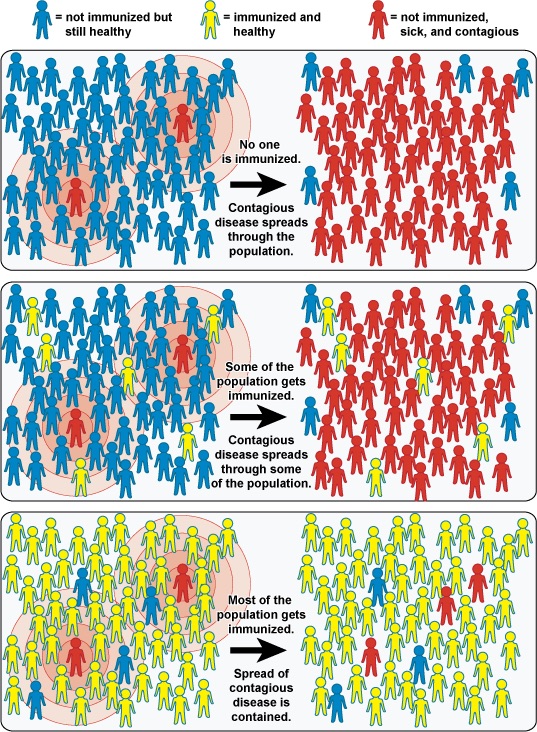
People who choose not to get vaccinations aren’t bad. But the story they tell themselves has dangerous side effects.

It took 200 years to eradicate smallpox, which couldn’t have been done without vaccinations. How quickly we forget that smallpox caused the death of 500 million people in the last century. Vaccinations are perhaps one of the greatest discoveries in medicine and remains the most effective method of preventing infectious diseases.

Yet, there have been many concerns raised about whether the benefits of vaccinations outweigh the cost. This is great. Because questions lead to more research and more testing and more discovery. But the problem we are seeing is people are ignoring the history, the science, the data while relying on celebrity gossip, science fiction, and biased reporting to make their decisions. This leads people down a road of picking your own truth. We are seeing a new epidemic – one that we don’t have a vaccination for – and that is free riding.

The free rider is someone who benefits from the collective, without making any contributions on their own. It’s contagious. We see it in economics, politics, communities, and government.

No one can excuse themselves from the responsibilities of being a citizen of the world. Anyone reading this has been blessed with opportunities, not guarantees. If you don’t show up, then someone else will have to pick up the slack in your stead. It’s draining. Don’t sit back and enjoy the ride. We need you and your contributions.

When Plan A doesn’t work

This might work. This might not work.

Business plans never go the way we want them to go. Neither does the housing market. Or the weather.

When Plan A doesn’t work, there are 25 other letters in the alphabet that you can use.

Thinking

Pema Chodron has a useful working meditation. When random thoughts arrive simply say the word, “Thinking.” Then go back to focusing on your breath and create more space for yourself.

If you’re stressed out because of work. Just say the word thinking. When your relationship with your spouse hits a bump – thinking. When you’re worried if you are not going to pay the bills, or if someone has said something that hurts you, or if you are feeling desperate (or lonely, or tired, or hungry) – thinking.

It also works when you trying to overcome something you are struggling with. If you have an urge for a cigarette, or want a drink, or feel the need to watch something that you shouldn’t be watching on your computer – thinking.

No need to over analyze whether these thoughts are good or bad. Shed the labels. You are not ignoring or hiding from your thoughts but letting them pass through you.

Be gentle and kind to yourself.

Financially rigged games

A rigged game is something that is fixed in a dishonest way to guarantee a desired outcome.

Here are some examples of rigged games:

  • Credit Cards – The national average is 15% interest.
  • Buying a new car – The average car payment is $485 over 86 months. Cars lose an average of 40% of its value in the first 4 years.
  • Leasing a car – Residual value (how much it will be worth when the lease ends); the lender may figure that a car selling for $30,000 today will be worth $15,000 4 years from now, and will calculate monthly payments to cover that loss in value.
  • 30 year mortgages – You can save over $85,000 in interest alone just by switching to a 15 year fixed rate (example used: 3% interest on a $200,000 house).
  • Personal Mortgage Insurance (PMI) – There simply is no need for it if you can be patient and put 20% down on your house.
  • Out of State Tuition – Average price is about $16,000 per semester for an out-of-state public university. That is about $9,000 more per semester for in-state universities.
  • FICO scores – You could have an income of over a million dollars this year with no debt and have a FICO score of 0. This is not a true measurement of wealth.
  • Waiting on Social Security – Those who are starting out in the work force can put away $100 a month in growth stock mutual funds with a long track record with returns in the 12% range will retire as millionaires. It is that simple. If you can’t put $100 away right now, can you do $80? $60? Just start putting something away.

Resist the foolish choice. Be patient. Challenge the status quo. Ask the question do I really need to play this game? Is there a different game I can play? Do not accept or comply with the idea that you need to have something. We are all smart and very capable people.

Don’t stop when you’re tired

Stop when you’re done.

No one signs up for a marathon thinking they are not going to get tired. Of course, you are going to get tired. Every runner has to find a place to put the tired if they are going to finish.

It’s a shame for the person who didn’t commit to go to the gym for 3 years and quits after 3 months.

Most people find a way to get from A to B in the shortest distance. So if it’s easy, everyone is already doing it. It’s not about the tactics. It’s about grit. It’s about pushing through the dip. If you are not ready to finish what you started, then don’t start.

Anything worth doing, is worth seeing through.

Trade secrets

During the destructive years of the dark ages, Europeans lost the art of glass blowing. It took several hundred years before tradesmen from Venice, Italy regained these techniques. The Venetian Merchant Fleet, who controlled the Mediterranean, monopolized the industry by banning the import of all foreign glass and exiled all the glassblowers to the island of Murano – effectively controlling the means of production.

This model of discovering and coveting was perfected during the industrial age: own the factory and get rich.

But when the World Wide Web came along it changed everything. Ideas became cheap. Because now we are connected to three billion people. The factory became the laptop and access is for anyone with 500 bucks.

In the age of connection, it’s no longer about who owns trade secrets rather who is sharing them. So when someone pirates your song, this is a good thing. It means someone out there has taken the time to find you. Your ideas begin to spread. And if it’s good, we’ll trade something for more of it.

The mistake people make today is thinking they can keep an eye on things. But there are no more islands to hide on. Monopolies don’t work anymore. The record industry is proof of this. And soon the movie industry will follow. Collaboration is on the rise. Look at Linux, or Kickstarter, or YouTube.

So let go. Loosen your grip. Give us what you have to offer. Don’t be afraid to let someone take your ideas. Sharing is what brings us closer together.

The fault is not in our stars

It’s fate to live in this specific time. It’s fate when we are born into a nationality. It’s fate when we are raised in a wealthy family. It’s fate because we have no control over the development of these events.

But character is not luck, chance, or destiny. Character is a learned attribute. No one is born with good character. It’s a skill that anyone can develop.

“It’s just the way I am,” is not an excuse for poor character. Because it’s not fate’s fault for where we are today. Our weakness of character is what causes us to act against our will.

“The fault, dear Brutus, is not in our stars, but in ourselves, that we are underlings.” – William Shakespeare (Julius Cesar)

Fate is what we begin with – what we inherit. Yet, it is character that determines how this journey will go.