Too good not to share

When we are proud of something, people have an innate desire to share this experience with others. Quite often though, we tend to hesitate because we are afraid of being judged.

Sharing your work–whether it is good or bad is not for you to decide–is the best way we can take advantage of these tools today.

The obstacles of sharing at a global scale is now gone. You can start a blog. You can post a video on YouTube for the whole world to see.

Sharing is what brings us closer together. Sharing is what builds more trust and attention. Now that the costs of production is virtually free, we can keep sharing our work again and again, getting better with each interaction.

Yes, your work will be judged. You will be criticized, torn apart. It’s okay. It’s not for them. Once we can see that the work we do is not for everyone but for someone, a whole new world opens up to us.

[Click send. Hit publish. Ship it. The change we seek to make doesn’t happen until after we share it with others. There is no art, no generosity, no project without some sort of interaction with the market.]
How to make a better prediction

Humans constantly fail to see the significance of our own creations. It makes us really bad at predicting what is going to happen next. Here are a few of my favorite examples:

“X-rays will prove to be a hoax.” – Lord Kelvin, President of the Royal Society, 1883.

“Everyone acquainted with the subject will recognize it as a conspicuous failure.” – Henry Morton, President of the Stevens Institute of Technology, commenting on Edison’s light bulb, 1880.

“Everything that can be invented has been invented.” – Charles Duell, U. S. Patent Office Commissioner Charles Duell, 1899.

“The horse is here to stay but the automobile is only a novelty–a fad.” – The President of the Michigan Savings Bank advising Henry Ford’s lawyer, Horace Rackham, not to invest in the Ford Motor Co., 1903.

“Television won’t last because people will soon get tired of staring at a plywood box every night.” – Darryl Zanuck, movie producer, 20th Century Fox, 1946.

“If excessive smoking actually plays a role in the production of lung cancer, it seems to be a minor one.” – W.C. Heuper, National Cancer Institute, 1954.

“There is no reason for any individual to have a computer in his home.” – Ken Olsen, Co-founder of the Digital Equipment Corporation, 1977.

“There is no chance that the iPhone is going to get any significant market share.” – Steve Ballmer, CEO of Microsoft, 2017.

The only way we can get better at predicting what is going to happen next is to write it down.

“I predict that this video will go viral.”
“I predict that at this price this product will boom.”
“I predict that this person will get the next promotion.”

There is no disputing the facts once we write something down. You have to stand behind your best guess. But once we see why our predictions are right or wrong, we can learn to make better ones in the future.

You still won’t always be right but you can learn to see better than the rest of us.

[We can’t see what is around the corner without first exploring the edges.]

Today’s urgent is not the same as tomorrow’s important

Getting to inbox zero, checking your social media status incessantly, sitting through another meeting, sending one more text seems important because of how urgent it feels.

Urgent is not the same as important.

The problem with short-term decision-making is that we leave a bigger hole to fill tomorrow.

If we don’t invest in tomorrow today, then when?

Yesterday would have been the best time to start, today is the next best thing.

Order of operations

Don’t seem very important until we do something out-of-order.

Too often, we fall into the trap of working on the fun, popular parts of the project, leaving the essential, arduous work for the end–when there is no more will to spare.

Start with what is important. Do the hard part first.

The culture we seek

There are two types of cultures: The one you buy into and the one you create.

Culture influences us in more ways than we can comprehend–how we dress, what we drive, what kind of house we live in, the food we eat, even down to the milk we drink.

Culture, like most things, is a story. A story that we are told to fit in with the lonely crowd.

There is an alternative. Instead of buying into what is being sold, you can create the culture around you. You can choose what is allowed in your life, who you spend your time with, where you go, how you you behave.

Seasons change. It’s okay to say goodbye to the old and welcome the new.

Improvisation

You are not going into the next scene of your story knowing beforehand what to do or what to say.

There is no script.

The answer then is to do improv.

The thing is, if we are spending our time demanding our boss for a script–a simple set of instructions to follow, or asking if this will be on the test, we are squashing a world of wonder and possibility.

No one is good at improv at first. Improv takes time to learn. We all stumble learning how to throw the ball in the air (and catching it).

Remember: We are all making things up as we go but all behavior makes sense from the actor’s perspective or else the actor wouldn’t do it.

Two types of learning

There is simple learning, which is learning how to do the same things better.

Then, there is generative learning, which is learning how to do new things.

For almost two hundred years, the industrial economy has valued simple learning. Do what you did yesterday, only faster and cheaper. This made us all very rich. It worked for a long time until the internet.

Thanks to the internet, we are no longer in the industrial economy, we are in the connection economy. The rules of the connection economy are totally different. We don’t know what to do next because there is no map, no step-by-step instructions. No one has done what we are doing right now.

Yet, what we see is people still waiting to be told what to do next. Waiting for the next big thing, while the internet and smart phones and Google are all staring right at us.

In 50 years from now, people will marvel that we were around when the internet started. Going to do the thing you always wanted to do, starting a movement, making a difference, may never be easier than it is today.

[Happy New Years, I hope that this year you will challenge yourself to learn something completely new. Learn how to code, blog every day, exercise more, read something that will stretch you, try a new sport, start a business, go vote. Go do that thing you always wanted to do.]

Paradoxes

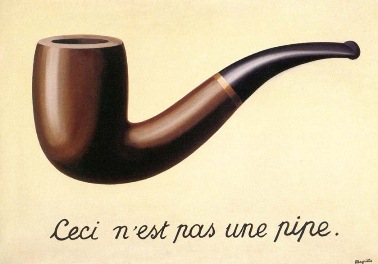
Example 1: La trahison des images also known as The Treachery of Images by René Magritte.

MagrittePipe

Ceci n’est pas une pipe. Translation: This is not a pipe.

Example 2: Liar’s Paradox

This sentence is false.
I am lying.
Everything I say is false.
Every person is a liar.

If this sentence is true, then the sentence is false, but if the sentence is false, then it must be true…

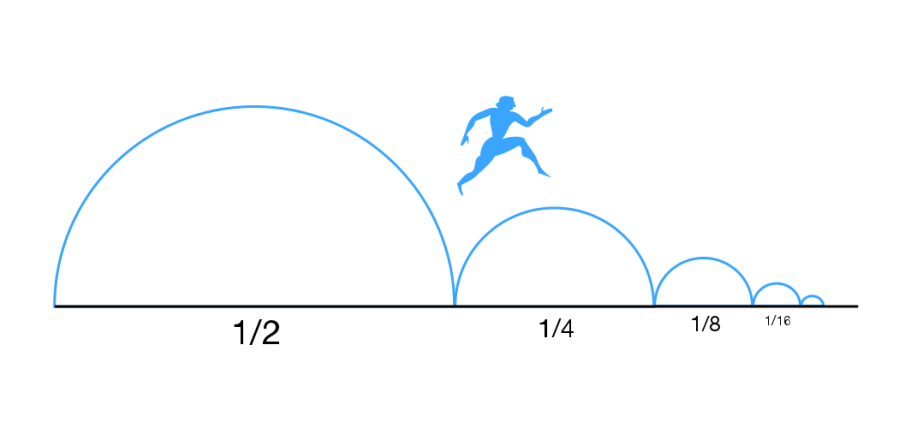
Example 3: *Zeno’s Paradox

Zeno_Dichotomy_Paradox

The idea that motion is but an illusion. As Aristotle put it, locomotion must arrive at the halfway stage before it arrives at the goal. Eventually, you are stuck in an infinite loop.

*Thank you, Martin Grandjean, for the image.

Other examples: Russell’s Paradox, Paradox of Court, The Crocodile Dilemma and a list of others.

The bottom line: There are things in our world that are totally true but cannot be proven. Sometimes we are stuck on difficult problems. Problems that are infinite in length. Instead of being caught in a loop, humans have a special ability to jump out of the system to ask why, to think about contradictions. Mechanical thinking is great for improving yields, crunching big data. Meta-thinking, the idea of thinking about thinking, helps us understand our place in the world, meaning and ultimately why we do the things we do.

I’ve never won an argument

And neither have you.

Because you can’t use anger to change the way how others perceive the world.

The recipient will only walk away from the conversation further cementing themselves into believing what they know. They are saying to themselves that they didn’t do a good enough job to get their point across. They’ll say you were being a jerk.

It gets us nowhere.

We are far more likely to have constructive dialogue when we recognize intent that we are all seekers of truth, that we can be persuadable in the face of evidence. Most of the time, we want the same thing.

We may not change someone’s mind (not all at once anyway). At the very least we can become more informed with how other’s see.

Who benefits from the work?

You.

You will benefit from the work you do. Your body of work gets stronger. Your posture improves. You get better at overcoming Resistance. You learn to dance with the fear.

Will everyone else?

Until someone can register, there is no benefit. Until we read it online, there is no urgency to act. Until we enroll, there is no change.

No one will benefit from the work you do until you ship it. Someone has to see, enroll, experience in order for change to happen. 

You are filled with a lot of ideas. Some are good and many will be awful. But ideas don’t spread until we share them with others.