Outcomes and effort

Bob Dylan once asked Leonard Cohen how long it took to write the song “Hallelujah.” Cohen replied, “Two years.”

But in fact, it took Cohen five years to write the song and when it was done, his label didn’t even want to release the album it appeared on.

Just because you poured your heart and soul into making a song, it doesn’t mean you’re going to get the recognition you deserve.

When we can learn is to divorce the effort with outcomes, it frees us. We don’t need all of our work to all pan out. We just need some of it to resonate with the people we seek to change.

Sometimes it takes time for your work to resonate. Other times, it won’t pan out.

You can’t control the outcomes but you can always control your effort. Once you’ve made a song, your job is to write another one.

When the great author, Stephen Pressfield, finally finished his first novel his mentor said, “Great. Now start the next one. Today.”

It’s as simple as that.

Without effort there are no desired outcomes.

Everything we want is on the other side of hard. Keep climbing.
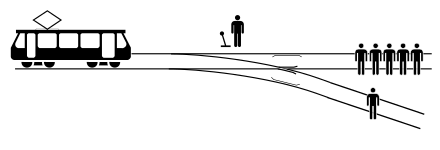
The trolley problem

Source: Wikipedia

You have a trolley barreling at full speed towards five people. Next to you is a lever, where if you pull-it it would shift the trolley to another track where one bystander is standing. The question is, What is the right thing to do?

It has been used as an example for all sorts of ethical dilemmas, but what I find fascinating is when we are present with a choice, we often get locked into those choices. (That is what standardized test reinforce.) A or B, which would you choose?

What we don’t see is another option: derail the train.

We are not usually in a position with no choices. It’s just the choices in front of us are not very good ones. But if we take a step back and recognize the degrees of freedom, we can find another solution that isn’t present in the moment.

Can you hold the tension while you wait for a solution to appear? Most of us don’t have the faith. We act quickly not because we want to be done, it’s because we lack the patience to wait and see.

How important is it to assign a number to something?

Some numbers are easy to understand.

You have a 1 in 13,983,816 chance in winning the lottery. And yet, some still choose to play knowing the odds but are not disappointed when they lose as a result.

Vegas creates an idea that if you are skilled enough than you could win. But when we do the math, the house always wins.

Yet again, despite the probabilities we overestimate our own abilities while we underestimate the challenge.

Numbers matter.

In the case of climate change, it is difficult to assign a number to the melting of the Greenland ice caps.

We know that it is happening. We don’t know exactly when they will be completely melted. 50 years? 100? Either way, it is hard to measure the damage it will cause. We just don’t know exactly. So, many don’t treat it as a threat. We don’t know the costs of inaction if the threat isn’t perceived.

Much like bankruptcy, it happens slowly then suddenly.

When we don’t know the likely hood of outcomes we apply different standards of probabilities. Difficult to calculate the worst case scenario when we can’t see it firsthand. Instead, we go rely on gut feelings.

“I’ll take that bet.”

When the problem is small enough, we can procrastinate without consequences. That time is already spent. So, what are we going to do about tomorrow? When do we start worrying about it?

Animate objects

If we were to flip a coin–tails I win, heads you win.

The coin is not bias. It has no narrative of the world around it. It doesn’t care how wins or loses. The coin doesn’t feel bad and its day isn’t ruined by the result. It’s an inanimate object.

But we care. We care who wins the toss.

So how can something that is made of matter, made of atoms in one form care, but not in another?

Further, how do you take a seemingly set of inanimate objects like blood and bones and get to “I”?

The same could be said about electricity. Connect a bunch of wires and you get electricity to use your toaster but with people you get thoughts and ideas.

HT GEB

Harm reduction

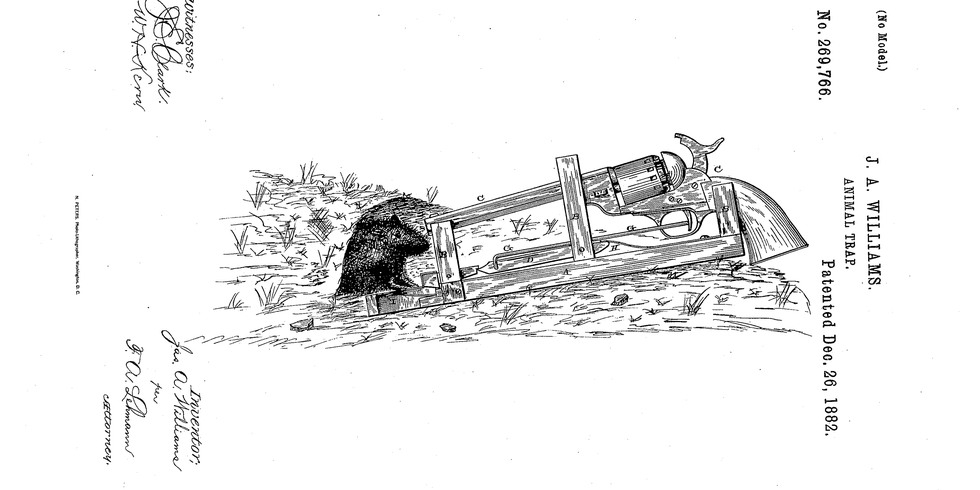
1882 Mousetrap Patent

Of course, looking at this patent today, there is a whole bunch of problems:

What happens if a child gets a hold of the gun?

What happens if an innocent bystander accidentally kicks it over?

What happens if the bullet travels further then expected?

What about the patch work you’ll have to do every time the trap goes off?

Is this even ethical?

Seems pretty silly to think about. But then you look around and see many of the same design faults today, you realize we are not so different.

Far too often, we have designed to maximize profit, not to minimize harm. Climate change continues to be a growing problem with most of our industrialized world contributing to carbon outputs.

And yet, the economic train keeps charging.

In Google’s original Code of Conduct it stated, “Don’t be evil.” But we have to be more proactive than this. It isn’t enough to simply design a mousetrap that isn’t cruel. We need to think of design in terms of commission AND omission. In other words:

“Do the right thing.”

Design must continue to evolve. We like to think we are much more sophisticated than the 1882 mousetrap patent. The truth is we have more technology but still fall into the same traps of our pasts. We have never had to design with this many people in mind.

Add in individuals, markets and political systems, each group is looking to apply different types of logic (both short-term and long-term thinking). Everyone has their own plan. Sometimes in the expense of others.

The bottom line here:

It’s not enough to sell a 3/4″ hole anymore. You have to think of impact. Are you contributing to the solution or are you still taking?

Fables

It turns out that if you left a frog in a pot of water and turned up the heat, the frog has the instincts to jump out and save her life.

The whole frog not being able to see what’s coming and being boiled alive is a myth. A fable.

Because frogs, like people, can sense danger. Regardless whether the threat is gradual or sudden.

That’s the power of stories, they have the ability to stick in our culture. Humans are story telling creatures and once an idea sticks it’s hard to loosen its grip.

Even if the story isn’t true.

Why post a blog every day?

Because you never know which blog post will be your greatest hit.

Because you have a voice and you must use it.

It doesn’t mean you should ship subpar work. On the contrary, it is the opposite:

Ship the best work you can do that day.

Write a song once per month and you have an album by the end of the year.

Write 250 words per day and you have a book by the end of the year.

Produce one water color picture per day and that’s enough to make a living.

Shipping is the key.

Progress over perfection.

Meetings and presentations

The only purpose of a meeting or a presentation is to change the emotion in the room.

Nothing else matters.

All the logistics can be sent via an email.

All the facts can be Googled.

What we need is to be convinced. A story we want to tell ourselves and to others (i.e. the board, the boss, our spouse, donors, etc.).

Change the emotion to change the world. If the meeting is to reassure ourselves, skip it and find something more interesting to talk about.

Exploring a finite world

It’s possible for someone to travel all the lands of the earth.

We have the means, we have the know how. Because the earth is finite, one could literally see everything.

And then what?

The questions I have is this:

Is knowledge limited to what we can see and experience?

Is a gut feeling enough of a witness?

Is faith simply enough?

What every paradox teaches us is that something can totally be true and still not be provable.

When we explore all the edges, what’s left?

I would argue that is where things get interesting.

Think about it.