Each of us have 6,000 thoughts per day

Which comes to about 375 times per hour while we are awake. As a culture, how can we experience such a massive amount of thoughts and yet talk so little about them? I think it’s because we are afraid. Afraid of being judged for thinking a certain way. Afraid to share the weird.

Thoughts are a roller coaster. They seem to originate as chemical signals from the back of the brain sent for our prefrontal cortex (that has the capacity for language) to interpret. Yet, we are quick to judge them as either good or bad. No matter how much you want to avoid thinking about a pink elephant it’s hard not to have your brain picture one right now.

So, how much control do we have with thoughts? It’s less than what we are comfortable admitting. Will power and altering the environment can take you only so far. And we can’t help there are chemicals and biology at work. There might be things we would never rationally consider. Yet, here they are. Indeed, it is difficult to fight our very nature.

Everyone has these kinds of “bad” thoughts but by no means are we bad people for having them. Instead of amplifying the voice in our head, giving it power, we can try to let them pass. We can give them a label. “Thinking…” is a good one. In the end, they are just thoughts. Nothing more. One of many. And soon they pass by like clouds.

You are not the reaction your brain has when you are sad, angry, depressed, or even happy. Be kinder to yourself as they rise.

On a side note, this is why I don’t subscribe to this myth that we don’t have any good ideas. With 6,000 per day, you are telling me you can’t come up with one idea worth sharing to make the world a better place?

“This is fine”

We all live a life that is inconsistent. We believe in things that are impossible to prove or explain. At the same time we want to see more evidence of things we are skeptical about.

The problem with inconsistent stories is they may not be true. No matter how much we want to believe them.

And then you end up like this dog:

It’s complicated to solve difficult problems. Even more difficult to find solutions when we don’t think there is a problem to begin with.

[Remember, oxygen was here long before Carl Wihelm Scheele discovered it.]

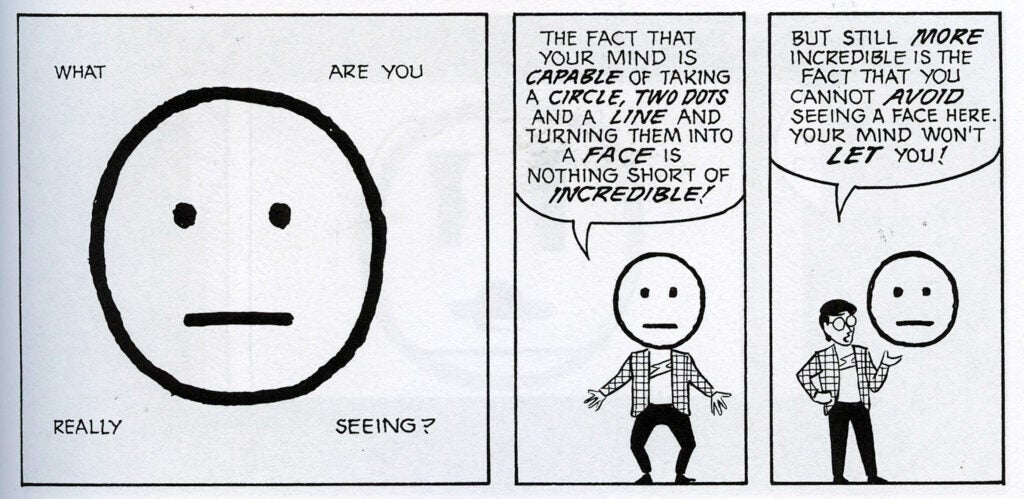
We all start in the abstract

Every person that is learning to draw begins with a stick figure. With practice, your technique gets better. Until you develop a style.

Shame keeps us away from pursuing our dreams of becoming an artist. It keeps us from even attempting something we are curious about.

You can’t learn to draw a masterpiece unless you start with the basics. Vulnerability is the key that opens that door of possibility.

Scott McCloud, Understanding Comics

High levels of achievement

Tennis legend, Andre Agassi, has some insight on this, “Now that I’ve won a slam, I know something very few people on earth are permitted to know. A win doesn’t feel as good as a loss feels bad, and the good feeling doesn’t last long as the bad. Not even close.”

…That’s rough.

It’s true, achieving that kind of level of mastery is something only a few will ever reach. I can’t even begin to imagine the time, commitment and sacrifice it takes to be considered one of the best at a certain craft. Yet, when we become too attached to the outcome we forget why we are even doing such things in the first place.

Agassi also points out, “Freed from the thoughts of winning, I instantly play better. I stop thinking, start feeling. My shots become a half-second quicker, my decisions become the product of instinct rather than logic.

There is no substitute for flow. When you reach the top of the mountain, there is only one decision to make. Keep climbing. Perhaps for different reasons now.

Attachment is detrimental to our experience.

More about the benefit of the doubt

We treat friends different than strangers. Information is less scrutinized by those we have given the benefit of the doubt to. And what we are taught at a young age often goes un-scrutinized too.

When we are born our minds are a blank slate. Like sponges we are constantly soaking in new information. As we get older, we develop the ability to critically think. So we are careful what we process. We don’t want to duplicate and we know what we like to think about–protecting our narrative of the world as we understand it.

That narrative is invented.

Familiarity with failure

How acquainted are you with failure?

Is it a daily thing or once per year?

Are you picking projects for the boss that you know you can succeed in?

What is the last failure you can point to?

You don’t need every idea to work, you just need one. Then you can do it again.

Failure is a process not a singular event. Don’t just show me your greatest hits, let me see you discard pile too.

The best sales reps know that with every rejection they are one step closer to making a sale. Why is it so hard for the rest of us to adopt this mindset? Because most companies don’t allow for anything else other than productivity.

Lighter wallets

1 in 5 people believe the new iPhone is worth going into debt for.

Don’t get me wrong, if you can afford the nice tools, get them by all means.

But…

We don’t need more space when you have a cloud. We don’t need more speed when everything is instance. The cameras are already better than anything from 20 years ago.

Think about how powerful each of these phones are today, what are we really purchasing?

We want status. We want the story we are going to tell by holding the new iPhone. And we are willing to trade something (time, energy, money…) for these artifacts. Even when they are against our own best interests.

Miracles

Each of us is an expression of the universe. Call it what you will. We are the results of millions of years of evolution in the making.

It’s a miracle.

An important reminder: Life is so precious because of how rare it is to find in the universe.

Deciding every day

Is now and then again tomorrow.

You’ve made the decision today to go to the gym or to sit down and type a page of your book.

And then you have to decide again to go to the gym or sit at your laptop. Because you don’t just reach your goals after one session. You have to do it again. And again and again.

Until you’ve reached your target weight or you have a book published.

The moment to decide (especially at the beginning) is constant decision we make. Creating cognitive load. Yet, now that I’ve published 2,000 blogs its not much of a decision anymore–it’s just what I do.

Getting to this point, to becoming the kind of person that wakes up before dawn to get to the gym or writing every day despite not feeling like it, is really hard. Necessary going for the long haul.