Dracula, Jaws, Arachnophobia…
All these horror movies led to the destruction of animals because our fears didn’t match the reality of risk we face.
The stories we tell are indeed wild.
Dracula, Jaws, Arachnophobia…
All these horror movies led to the destruction of animals because our fears didn’t match the reality of risk we face.
The stories we tell are indeed wild.
Despite our best efforts, you can’t actually tell your brain not to do something.
There is a lot of important application to this.
If we are focused on all the roadblocks, what does our brain do? Focuses on all the roadblocks.
However, when we decide then to focus on the path through now it is intent on finding a solution.
We can’t obviously control all the noise but with some intent, we can point it in a better direction.
This is my 2,500th consecutive blog post.
Streaks are much more helpful in the long run. In the beginning, it is easy to break one. At this point now, it is no longer a question of if I am going to write but rather what.
The lifetime pursuit is different than writing a book though. Writing a book has a beginning and an end. Once it is complete, you can take a break and start a new one. Writing every day for the rest of your life is a routine or a practice. Something to help overcome the narration.
The goal is to leave a large body of work. Too look back and see something you are proud to put your name on.
Arguments challenge our authority and status. They can often get in the way with building a relationship. Especially, when we can’t find a healthy way to resolve conflict.
The question is, what is it for?
To gain something that is lost? To hide from something we are afraid of? To make a stand at an invisible line you drew in the hypothetical sandbox?
Why are you having this argument? When you can identify your needs, you will spend less time arguing and instead move closer to finding a solution.
How We Got to Now: Steven Johnson’s brilliant book connects the dots of the printing press to the discovery that we are not the center of the universe and how air conditioning changed the political landscape for Republicans.
The Perfectionist’s Guide to Losing Control: Katherine Morgan Schafler explains that perfectism is a phenomenon and not necessarily a disorder. In an adaptive way, can be an asset when channeled the correct way. It is also way more nuance than we are led to believe.
The Carbon Almanac: A tremendous feat to gather over 300 climatologists from around the world to put together straightforward information about the climate crisis. Easy. Digestible. Essential. Everyone should pick up a copy. You will realize that you know more than you think you do (and many more are ready to act than you think too). It isn’t too late.
Combatting Cult Mond Control: The kind of book our culture could label dangerous. Not for everyone but essential in understanding undue influence that plagues our world in more places than we realize. Not just in the shadows but right out in the open for all to see (yet not recognize).
iGen: If you want to better understand how anyone who grew up with a cell phone in their hands, this is an important read. Individualism explains so much of where anyone under 30 is coming from. Not only has this helped me in running our nonprofit, it also has shifted how I think about parenting going forward.
Our whole idea of perfectionism is entirely wrong. We think it means to be flawless or to do a task without any errors. No rough edges left to sand.
But in actuality, the word perfect comes from the Latin word perficere. Broken down, per means complete, and ficere which means do.
In other words, perfect means to be completely done. It has nothing to do with the absence of errors. It means to be whole.
Flaws are a (perfect) place to hide. We can’t possibly share our work with the world if it isn’t without mistakes. But that is just an excuse. The best books could have been made better. So is the case for the best paintings, songs, and speeches. Perfect is complete despite the weaknesses of your work.
HT The Perfectionist’s Guide to Losing Control
The printing press is one of the most important inventions in the last 500 years. Not only did it deliver The Bible into the hands of the commons–it also challenged the authority of the church and its clergy, and literacy shot up as a result. Scribes were no longer valuable which rocked the whole industry of how literature was distributed.
While the printing press solved many problems, it created more. Once people were handed a book, many realized they were far-sighted. So, spectacles all of sudden became an important commodity. Which led to the innovation of glass. And with that innovation came microscropes that eventually discovered germs. At the same time, others were looking into the sky with now invented microscopes. Which in term, led to the discovery that we were no longer the center of the universe.
This is the effect that one change can make. Each of us has a far more reach than we even realize.
HT How we got here
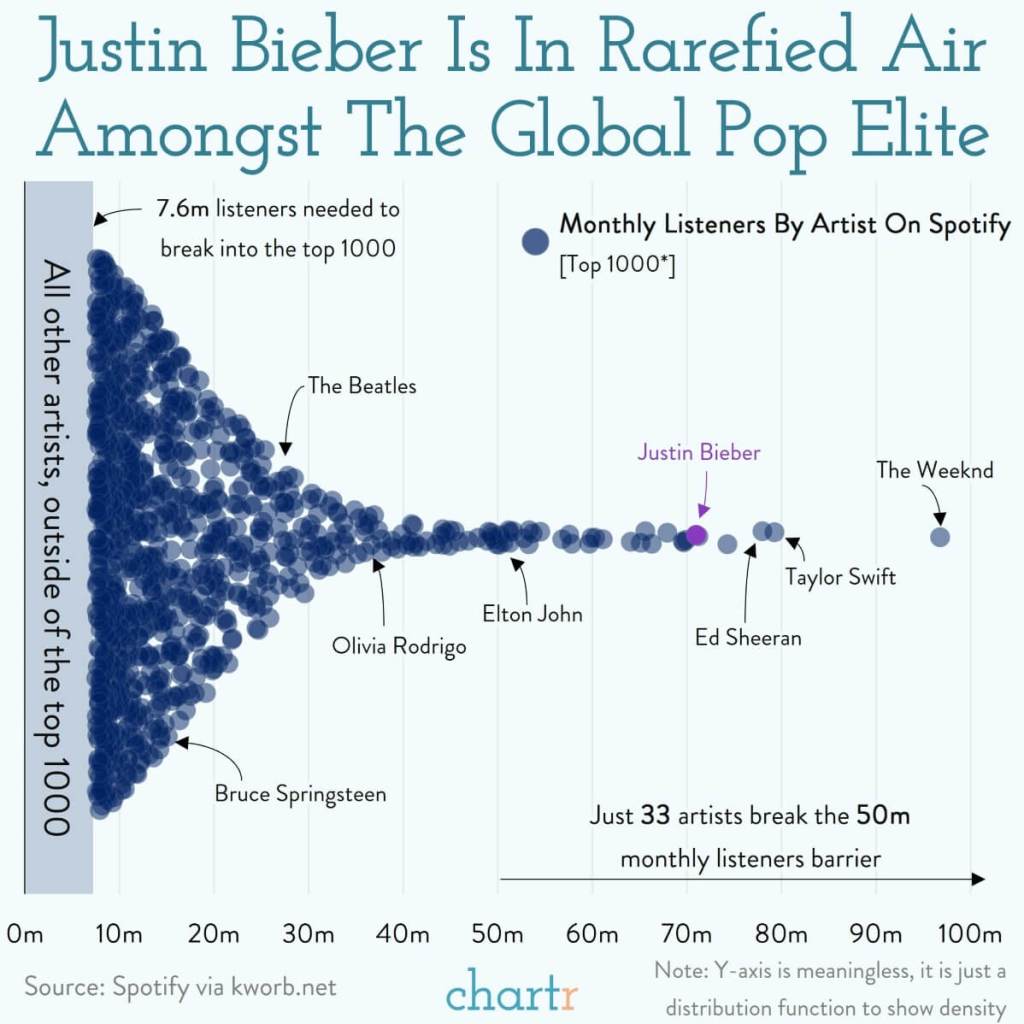
Chartr shows that only 33 artists are breaking the 50 million monthly listener barrier. 33. That is it.
Popularity is an enticing number for all of us to chase. Likes, shares, and downloads are easy to measure. We assume that the higher the number the better the music/art must be. But that isn’t the case. Are we to assume that The Weeknd has a better catalog than The Beetles? Of course not. That is open to interpretation.
Great music is about taste. There is plenty of great music that never charts but that doesn’t mean it is junk. Much like this blog. It is in the corner of the internet under a mountain of other blogs that only a few will read (in terms of the world).
And yet, it is still worth writing. It is still worth producing. Art makes the world a better place regardless if it ever goes viral.
You didn’t get to bed on time and so you are late for work.
You are late for work so you run the red light.
You got in an accident because you ran the red light.
These things happen all the time. We become so hyper-focused on the outcome of the last decision that we ignore the ten decisions that led before that.
This is an avalanche problem: One bad decision that leads to even more bad decisions.
Avalanche forecasters have a set of checklists they use to figure out if a slope is safe enough to ski. It isn’t foolproof, but you can certainly save yourself a lot of heartache by observing the conditions around you to avoid these traps.
It is also worth pointing out, that one positive decision can lead to more favorable outcomes too.
It’s obviously a throwing problem. If you throw a ball too far away, we are now reaching making it difficult to set up the next throw. If you throw the ball in the correct zone, the catching takes care of itself.
While most of us don’t know how to juggle, we know how to juggle the many tasks associated with a connected economy.
The visual cannot escape me. We fall short when we are out of balance. Perhaps, it is also better to let some of the balls fall down and focus on the ones we can keep up.
From what I observe, we juggle too much. YMMV.
 Josh Allred's Blog