Disorientation

Isabel Wilkerson in her brilliant and essential book, Caste, explains that America has a history of social stratification based on race. That those who see the world, most of the time ignorantly, with this racist lens, often confess a sense of losing power and that the world is being morphed into something against them. What’s going on here?

It’s a “us versus them” under-siege mentality. Hence why free speech is such a hot topic right now or why “cancel culture” is a thing. Many are left with the feeling that they don’t have the capacity to speak, that no one is listening, and that they are told to be silent. The things they have always believed in (ideals, institutions, systems) are now “verboten” to the point that they are feeling culturally dismissed. This a difficult pill to swallow. As people age and think that they should have more power, not less. That they should see the world with more clarity, not less. That they should have more choices, not fewer. Which causes this sense of losing hegemony.

To many who fall into this cultural trap, they see the ground shrinking beneath their feet. They feel lost and as a result, look for someone or something to blame. Hence the targets of minorities such as LGBTQIA+, immigrants, and race. But it also spills into policy and how tax money is spent on social programs.

Ultimately, this all leads to a constant sense of disorientation. This change is experienced much differently across social and economic lines. But as a whole, the false promise that aligns these groups is to resolve this disorientation–to make sense of the world and to restore it to how things used to be.

“At its core is a nostalgic promise that you won’t have to feel like your own country has changed in a way you don’t recognize it and it doesn’t recognize you.” – Ezra Klein

Shout out to Ezra Klein on this one. Something that I have been seeing in our culture for a while but could not find a word for it.

Torchbearers

“This is the true joy in life, being used for a purpose recognized by yourself as a mighty one. Being a force of nature instead of a feverish, selfish little clod of ailments and grievances, complaining that the world will not devote itself to making you happy. I am of the opinion that my life belongs to the whole community and as long as I live, it is my privilege to do for it what I can. I want to be thoroughly used up when I die, for the harder I work, the more I live. I rejoice in life for its own sake. Life is no brief candle to me. It is a sort of splendid torch which I have got hold of for the moment and I want to make it burn as brightly as possible before handing it on to future generations.” – George Bernard Shaw

I have found this quote so comforting. So much of what we do, we think doesn’t carry any weight. But when you rewrite the story as the human race, then everyone has a job to do.

Earth rotates around the Sun

Something so universally accepted at this point today. But can you imagine how Galileo Galilei must have felt when he had the proof and no one would listen? How frustrated he must have felt being thrown into house arrest for the rest of his life for challenging the Church?

It’s a story of caution. Just cause we don’t like what we hear doesn’t mean it isn’t true.

Polishing

Your work is never complete. It is just another iteration until you are ready to be done.

It will certainly look different with more polishing from before. And since everyone sees the world differently, it may not even be seen as better with more time.

The good news, when you are ready to move on you can now go work on the next thing.

AlphaGo

It is said that the board game, Go, has more moves and variations than there are atoms in the universe. Even if that is a bit of an exaggeration, the number of possible moves is wild. It makes chess look like checkers. Go is the oldest and most popular board game in human history.

It should be no surprise to discover that AI was built to see if it could beat humans. And in 2016, it succeeded beating Go Master, Lee Sedol, in four out of five matches. But the thing that surprised the world more than AI beating a human at Go was what happened on Move 37.

Move 37 has been described as the moment in this particular match where the opponent must decide whether they are going to play offense or defense. Instead, AlphaGo played a surprise move that no human would ever play. In fact, it would have been a 1 in 10,000 chance a human would pick this strategy. It shocked so many viewers that many wondered if it was a mistake or a bad move. Lee Sedol was taken aback that he had to leave the room and go take a walk. It was a never before seen type of move in the Go world.

We don’t feel comfortable with the idea that AI can be creative. That has been one of human’s greatest strengths. The difference is humans can only draw from their own experience while AI can draw from the collective.

The lesson is clear: AI doesn’t have a narrative. When built correctly, it will follow the data. It isn’t constrained to play the game as we have been taught. As a result, opens new possibilities that we can’t possibly see because of our biases and prejudices that get in the way. In other words, it doesn’t play the game as we see it.

Courage follows

Most of us believe that you gain the courage and then you go do something that scares you. But it is the other way around. Do the thing you are scared to do first and then the courage follows.

It feels counter-intuitive. But you are much more likely to create art, stand on a TED stage, or leave a toxic job if you can do the action first before waiting to get in the mood.

Anger versus contempt

There is a difference between being angry with someone and having contempt for them.

Anger is relational, a natural type of thing in any long-term relationship. Friction and tension build up over time to a point where it spills over and releases. The conflict then arises and there is an opportunity to resolve it. If resolved in a healthy way, these types of obstacles can bring people closer together.

Contempt, on the other hand, is totally different. Contempt says, “I can’t even deal with this person.” So, what do we do? We swipe left. We block them. We avoid them altogether. This is a huge cultural shift in this day of age with life on social media. You can simply choose to opt-out. And it can have a negative effect on our relationships.

If you are feeling lonely, it may be worth examining how some of your relationships have recently ended. With conflict that perhaps could have been resolved or without it altogether?

Monochromatic

Robert Ryman is famous for his “white on white” type of paintings. Many will ask the question, “How is this art?”

Art is anything we do that brings emotional labor to the table to make connections. The very fact that it sparks a question of intrigue or even frustration from the viewer makes it art. “I could do that!”

Ryman saw what others can’t see. And that is the job of the best artists in the world is to draw you in and think.

The only limits we have are the ones we put on ourselves.

Post, 1981 by Robert Ryman

Lithuanian Press Ban

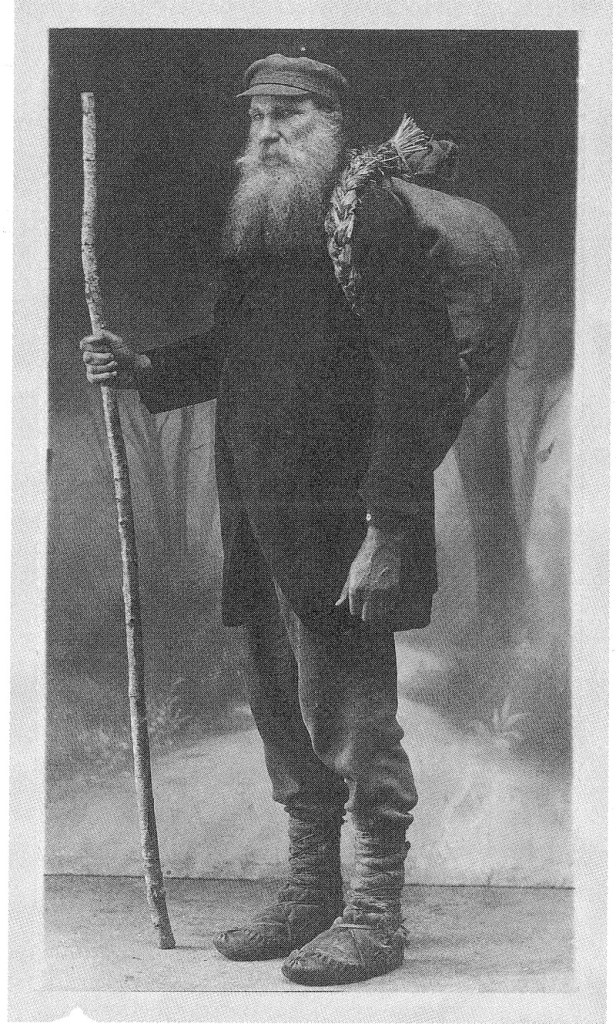
As punishment for the January Uprising and an attempt to Russify Lithuania, from 1865 until 1904 it was illegal to print or distribute any books in Latin within the Russian Empire. To counter this, Lithuanians organized printing outside the Empire’s reach and smuggled books in. Stores were put up as fronts for underground bookstores. The ban was mostly unsuccessful. In the final years, 30,000 to 40,000 books were “illegally” brought in.

While access to material is so easy today, we forget that people have violently fought for their right to learn along the way. I’ve been asked before if the books I read would be considered dangerous. My response is, “Only if you read them.” It’s a touch dramatic but to read is to see. To see is to change.

Vincas Juška, Lithuanian Book Smuggler

Bandwidth

The more one reduces daily life obligations and maintenance, the more capacity one has to be creative.

Capacity is the keyword here. Because having discretionary time doesn’t mean you choose to engage in the process of making something. In fact, most just jump on Twitter or Netflix.

Often, people make the mistake of confusing time with freedom. Freedom thrives with a structure which means constraints.

What makes creative people creative isn’t having some Muse visit them throughout the day. Creative people carve out time to do creative acts.

They serve their art because art doesn’t serve anyone.