Stuck

There are many reasons we are stuck. That is why we maintain a holding pattern longer than we should. Here are some reasons why:

  1. We are too afraid of the unknown.
  2. We don’t think we have any choice. And yet, in most instances, the only choices left are hard to make.
  3. We think that our future selves will be better at solving the problem.
  4. We think we lack something. Resources like money, time, energy, education…
  5. We have people counting on us and don’t want to let them down.
  6. Our ego is too large. We can’t admit when we are wrong.
  7. We lack prajna–seeing the world as it really is.
  8. Our narration, the story we tell ourselves, is telling a story of inefficiency.
  9. We are not accustomed to leaping.
  10. We feel the need to ask permission. That the boss will say no.
  11. We are looking for safety and reliability, a sure thing, and a guarantee something will work before you begin.
  12. We are afraid of failure.
  13. Our status is in jeopardy.
  14. We don’t want to use the emotional labor it takes to be creative.
  15. You occupy your time with email, Twitter, and Netflix.
  16. You spam people on LinkedIn instead of going to a conference.
  17. You say you have “writer’s block.”
  18. Your idea is too large to pull off.
  19. After 12 years of schooling believe that compliance is a valuable skill.
  20. You have a poor locus of control.

There are lots of things we do to self-sabotage our work. The thing I constantly see is that people simply haven’t made a choice. It is a choice to show up to work today. And when people forget they are making one each day, it enlarges the feeling of being stuck.
No creature with more hubris

It’s us. We are more hubris than any other creature on this planet. The other day, I received a voicemail of morse code. It was a clever scam. I have no doubt that if you deciphered it, it would eventually lead to a conspiracy that would have ultimately led to giving my social security number. The ruse only works if we want something bad enough that we are willing to suspend reality to have it. “Of course, someone out there needs me!”

That’s why Charles Ponzi, a century later, is still remembered because it is a warning for how vulnerable (and gullible) human beings are. Our motives are effective at suspending reality.

Categories are all invented

Humans continuously classify things to make sense of the world. However, we don’t pause long enough to see that the way we classify objects is all fictional.

For example, a Category 2 hurricane has sustained winds of 96 to 110 miles per hour. If we add one more mile to equal 111, we are now in a Category 3 hurricane. Category 3 hurricanes are considered major and would get lots of news attention. Just by adding that one mile per hour, we change the story of the storm.

All of these stories are made up. Who do we marginalize by the categories we create? What do we over blow? What can we not see because of our point of view?

“You’re fired!”

Once you play with a fax machine for the first time, an early adopter can see that such a tool would be useful amongst the population. The network effect dictates that the more people that used fax machines, the better it was.

Back to the Future Part II

In Back to the Future Part II, which was filmed in 1989, they predicted that the fax machine would be an important tool of communication. That every household would have 4 or 5 of these things. Now, most fax machines are confined to an office and are practically obsolete.

While we might be good at predicting something at first, we have a hard predicting the application of something in the long run.

Staring contest

When staring at a mirror and looking at an image of yourself, who blinks first?

When we look in the mirror, we see what we want to see. All the flaws and imperfections are just part of the story we tell ourselves.

If it all goes according to plan

Great, what a pleasant surprise. We can count ourselves lucky and continue to push forward.

But it usually doesn’t go as planned. Which is why we need to build resiliency into our plans. Slack when things fail. A backup plan when things fall apart. A way to pivot. And then…we can continue to push forward.

The path isn’t straight. But progress can be measured not in the destination but in the steps that led you there.

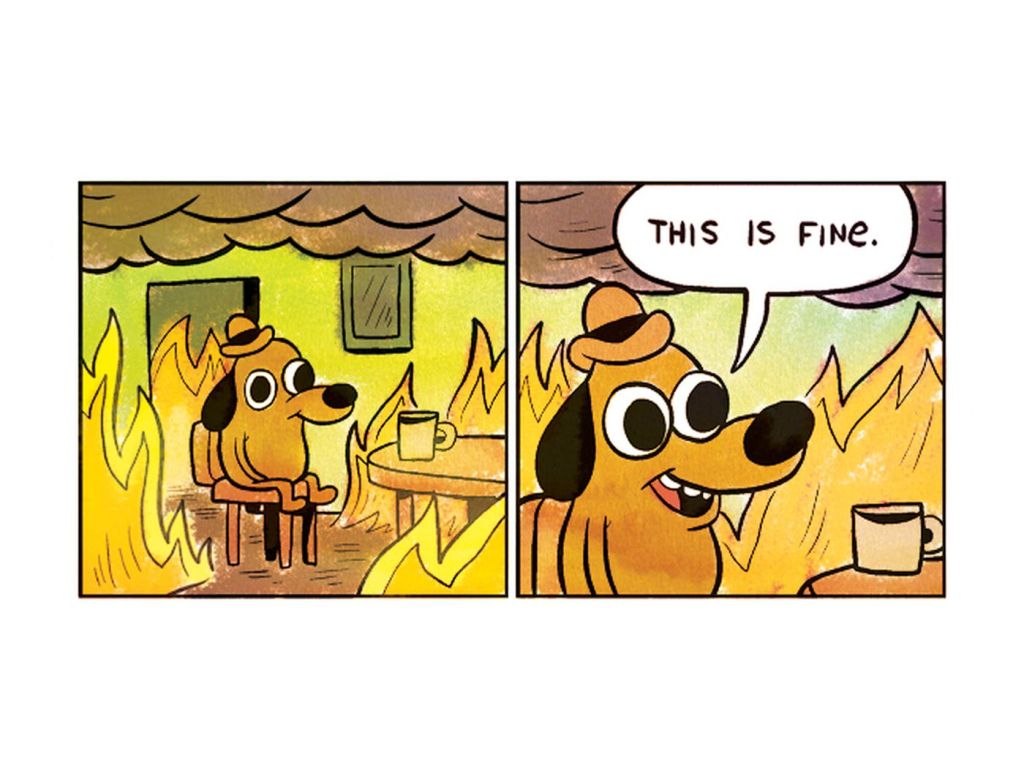
“This is fine”

I was talking to someone recently about solving the urgent problem of climate change. To which they replied, “I just don’t feel like anything I do will fix this.”

It breaks my heart to hear this. That the culture has worked so hard to get us to believe that we are not special and that we cannot make a difference. For a problem that is solvable. If a problem was unsolvable it would be a situation, not something that can be changed.

One of the ways to get started is to understand the problem. When we can reframe the story we tell, we can define the path forward.

Coal, combustion, cows and concrete make up 70% of the climate change crisis. On top of that, 55% of the US population believes climate change is concerning or alarming. Only 20% are dismissive of climate change. To which I say, good riddance. We can leave these laggards alone. You don’t need them to change things.

You don’t need to change everyone, just someone. Enough “someones” and the tide changes.

HT The Carbon Almanac

Samizdat

It translates to “self-publishing.” During the Soviet Union, there were many books censored for the public. As a result, a grassroots effort started as a form of protest by reproducing these books and distributing them. The problem was that most printing presses and typewriters had to be registered. To avoid the secret police most were rewritten by hand. Making the process painstaking and slow. But with time, “dangerous” books began to circulate in small circles again.

I once was asked if any of the books on my bookshelf were dangerous. I replied, “Only if you read them.”

Writing and reading remain one of the most important (if not the most important) tools at our disposal. When we educate ourselves and learn, there is no telling what we can accomplish. Indeed, when we numb ourselves and lull ourselves into sleep, apathy kicks in. Literature inspires the heart. It is why those who exercise power unjustly don’t want to see the masses educated. Just enough to be compliant.

Dreams

Dreams are a one-way street. You can chase your dreams but your dreams won’t chase you.

The world needs more people to follow their dreams. It was easy to dream about being an astronaut when you were young but when you get older and “reality” sets in, you push those dreams to the side.

That’s what 12 years of schooling will do. It didn’t train us to reach for the stars but to fit in and be alike. The only way an economy works is if we participate. And so, we settle for a job.

If you are still dreaming then you are not too old to follow them.

Whose expectations are you looking to fill?

It is a dangerous road to take to fulfill other people’s expectations. The work suffers as you try to water it down for “everyone” to understand and agree with.

The irony is when you started your work you were probably trying to learn something about yourself. And in the process we forget to explore in the face of trying to be popular.