Myths

Four out of ten Americans believe in ghosts, demons, and other supernatural entities. One and five believe they have seen a ghost.

Yet, despite the lack of evidence to support that we live in a demon-haunted world, people still choose to believe in their existence.

Sometimes charlatans can trick us. Far more often, we choose to see what we want to see. As demonstrated by Simons and Chamboris:

We can’t take in all the information. Instead, we create short-cuts to find the patterns. If we believe in a demon-haunted world, we are looking to fulfill that prophecy. Hence why we see faces in the sky.
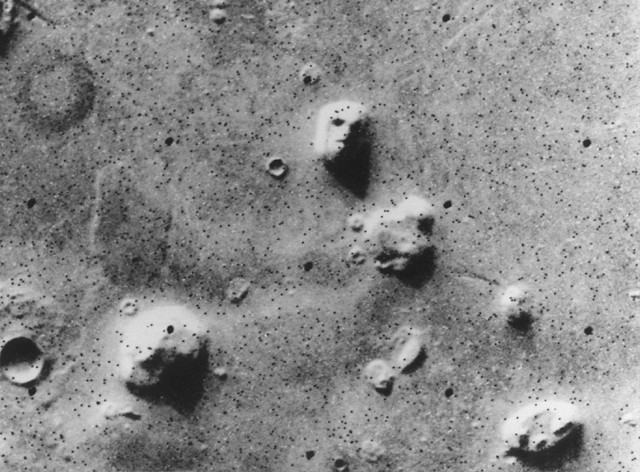
The famous Cydonia Images of Mars

Since people could see a face, some scientists demanded further explanation. Costing millions of dollars and countless hours just to be sure.

Cydonia is nothing more than an optical illusion.

And what they found was an illusion. Indeed, it is difficult to separate shadows from the light when we are forcing the world to fit into our narrative rather than changing ours.

Man’s best friend

Why are dogs known as man’s best friend?

It turns out that dogs were the first animal ever to be domesticated by humans. In fact, they were domesticated before the agricultural revolution 15,000 years ago.

Dogs have been with us to hunt, to fight off predators, warn us of danger–earning them the title of “man’s best friend”.

There are lots of things we say, but we have no idea what they actually mean or where they come from.

“It’s raining cats and dogs.”

“There is more than one way to skin a cat.”

Of course, dogs are not usually people’s best friends. Humans are not literal creatures. We are story-telling ones.

Starting a new chapter

Today, I want to lose 20 pounds.

Of course, I can’t actually do that unless you find a way to cheat.

The same can be said for becoming a doctor or lawyer.

What you can do instead is turn toward a direction and develop the habits of the person who it is you are trying to become.

Ellen Langer has said for anyone wants to become an artist only needs to start doing art.

If you want to become a marathon runner, it helps identify what marathon runners do–which is simply run. If you are not running, then what are you doing?

The ones who walked away

Imagine a utopia where there are no kings or rulers, where everyone is prosperous and no one goes hungry. There are celebrations on the street. Imagine this place didn’t have currency. There was no need to work. You spent your time doing what you wanted: making art, learning, spending time with family and friends. Everyone in this place had all the means they would ever need and then some.

In 1973, Ursula K. Le Guin wrote a short story about this type of utopia. Omella she called it. Except with one caveat:

Can you sacrifice one innocent child to a life of pain and suffering for everyone else to be happy?

Imagine that paradise hinged on this child’s suffering. The child was locked in a small closet basement with no light or windows. No fresh air. No sanitation. And in order for the society to function, you must leave this child be. That was the rule. You could visit this child but you couldn’t give them any love or encouragement. No learning or care. Just leave enough food for them to survive. That’s it.

Some of the citizens of Omela never worried about the child. Out of site, out of mind. A few would go visit the child and leave in tears. Changed by the experience. And a couple, leave the city all together.

Because how can one be happy if it hinged on the suffering of a few?

It is a fascinating thought experiment that has left me speechless. And when you start thinking about the systems we have set in place, and the inequality that faces our world, it’s difficult to think of throwing away leftovers when 800 million go to bed hungry. Or how you can turn on the light when the sun goes down and not worry about pollution from kerosine lantern slowly killing you each day. Or how some of us can turn on the tap and we are so used to clean drinking water coming out while hundreds of millions suffer without access.

Just like the child, each of us hears rumblings throughout the world. Cries from the unjust. We don’t want to believe that someone is working $2 per hour to enjoy a pair of Nikes. But it happens. Once you see it, you can’t unsee it. The opportunity then going forward isn’t to walk away from it all but instead to fight for a more just world.

Legal fiction

Apple is one of the most successful companies of all time. It’s an icon that most in the world can recognize. But does it really exist?

Take away all the workers, you could hire new ones. Take away all the phones, you could build new ones. Get rid of all the shareholders, and many will line up to replace them. But, if the company was ordered to be shut down, the factories would remain standing, the workers would continue living and find other jobs, the shareholders would move their investments. Apple would be gone. Vanished. That’s because Apple is an idea, a figment of our imagination, or as lawyers call it legal fiction. In this example of Apple, it is something that you can point to but isn’t a physical object. This computer I am typing on is a computer with a bitten apple on it. But the apple is just a logo. Apple the corporation is an idea. An agreement of what it is. The sum of the parts that makes an invisible entity.

This is what I mean on this blog when I say, “It’s all invented.” Democracy, for instance, is an idea not an object. And so is freedom, equality, companies, property…all human inventions. This is one of humanity’s greatest inventions: to create ideas with no physical structure. We are not bound to only create things that we can only see. Stack a bunch of brick together and you don’t just have bricks, now you have a home!

We can create ideas that spread that can be used for good or one’s own gain. Propaganda obviously can be a powerful tool. One that rallies the masses towards a cause greater than ourselves or to justify atrocity.

We are not bound to the lengths of a page. And once we recognize these structures are invented, we can invent new ones, better ones that create a more just world.

Working together

Convincing everyone that money, a simple piece of paper with a number on it, has value is quite extraordinary if you think about it. That we all agree if you have enough of this finite resource, this made-up invention brings status, power, convenience, security, etc. Currency was only invented 5,000 years ago. A new invention when you compare it to the age of the Earth. Yet, old enough, ubiquitous enough, that we all accept it.

Further, how do you convince millions upon millions of people to obey traffic laws? How do you persuade people every morning to get up and go to work? That people must pay their debts, get a job, contribute, pay taxes, worship? How do you reassure people everything will be okay in a crisis or to be compliant?

Telling stories indeed is not easy but telling stories is how we change people’s minds. Tell the right story (at the right time), or hear the same stories long enough, you can begin to believe in things that may not be true. As Orwell would put it, doublethink. We forget it is all invented. That many things in our culture are silent agreements so that we can make the culture function better.

This is why we have traffic stops. It’s a practical solution to transport the masses. Even if it’s unlikely I will get pulled over if I run this red but the thought that I might get pulled over keeps me in check. Since we don’t want to live in a culture where people run reds for convenience, we decide to be compliant for our safety and others. We don’t want to risk running through lights just because we are late for a meeting. If everyone did this, everyone would always be late.

The culture, the people work better together with cooperation. And while it feels like the divide is so vast between groups, we agree upon way more than we even realize.

Best available information

Most of the big papers echo each other. Someone can write an article and site that another paper broke the story using a link.

Most people don’t click the link.

We trust that someone must have vetted this. After all, we are reading and subscribing to this source, there is some sort of trust involved at this point if I am giving them attention.

A while back, the New York Times posted an article using a study linking higher death rates of Coronavirus with air pollution. Interesting. Here’s the problem: The study hasn’t gone through the peer review process yet! In this example, the media is pushing for clicks and entertainment not to inform people of the problems at hand.

When is the last time you clicked and read the actual study or report or piece of evidence that the news is reporting? Because again, we all assume, someone must have vetted it.

The information, the scientific review process even, while not perfect is the best we got. But are you doing the best you got to seek the information?

As always, once we obtain new information, we must have the courage to change our minds.

Story-driven

Human beings are irrational creatures. This is why fake back surgery is also as successful as real ones. Or why cheap wine can taste as good as the expensive stuff when blindfolded. We can trick ourselves into believing anything. We can double think, believe in two contradicting/opposing views at the same time. Believe that Princess Diana died and is still alive today. We can read 99 5-star reviews about our work but get down about the one person who didn’t like it. We struggle as tensions build in a conversation–especially when the conversation is around us and things we can’t change. We can ignore science and believe in things we can’t see.

Humans are story-driven. We cherry-pick the information and plant it into a story we are already telling ourselves about the world. None of us are rational, regardless of whether we think we are the exception.

Navigating or creating

Sailors use charts to figure out where it is they want to go. And for most of us, life can feel like navigation. Trying to get through the day with as little inconvenience or pain as possible. Finding the easy path through challenges. Getting from Point A to Point B as fast as possible.

The problem is, this isn’t the only way to live our life. After all, when our time is up, we all end up in the same place. Instead of trying to navigate through life, we can work on creating the life we always imagined is a much better approach.

We can be deliberate in defining what a life of joy or success looks like. For some, it might be money. But that will only take you so far and is really only one silly way to measure.

Imagine the life you want to create, and go out and do it.

Semiotics

Semiotics is the study of signs and symbols and how we interpret them. As humans, this is how we can interpret a world with limited information. Driving down the street, I might not know this neighbor but I can tell something about them if they are flying a Gadsden or a transgender flag. These are signals we are sending to the world for others to interpret. We are letting people know who we are and what we are standing for.

Of course, this isn’t just flags but the clothes we wear, the food we eat, the team we root for, the vehicle we drive, whether we choose to wear a mask or not. All signals we are sending to formulate a story we are telling ourselves of how we see the world and the story we are telling others.