In epidemiology, you can assign a number of how many people a disease can spread from person to person.
For the 1918 Spanish Flu, it had an R0 value of 1.4 to 2.8. This means if you got the Spanish Flu then you were likely to spread it to just under three people.
It turns out, ideas work the same way too. When an idea takes hold of us, we are likely to spread it to the others. If the idea is sticky, we will remember it for years to come.
Which is why you can hear a song that you used to listen to in high school and instantly be transported back to the that time.
Sticky.
Music is sticky because it follows a rhythm. Your idea can have a rhythm to it too.
The day I announced to my-coworkers at my old job that I was leaving my 9 to 5 to start Pivot Adventure, many said, “Wow, that’s amazing” to my face. I found out later that most of them said another behind my back.
They thought I was crazy, and that it would never work, that it has never been done before.
The truth is, the ship is never going to feel close enough to the dock. No one knows what will work, what will go viral. No one has a crystal ball. And we are terrible at predicting what happens next.
I spent over a year preparing for that step. Waking up early and going to bed late to prepare for every scenario. Getting out of debt and saving every penny. All that was left was the guts to take it.
(I didn’t know that it was going to take six months before I make my first dollar. If I did, I probably would have been too scared to do it. Perhaps, I would still be at my old job wishing I would have tried.)
The thing is, most people will play it safe. Most people prefer to be told what to do next. They want the simple set of instructions. That doesn’t have to be you.
It doesn’t mean we need to push all our chips in. No, quite the opposite. Be calculated, be realistic, have enough to start.
Build a resilient system.
Then go.
Stop living below your potential.
Making sensible decisions means never taking risks. Living to you potential means risk and emotional exposure.
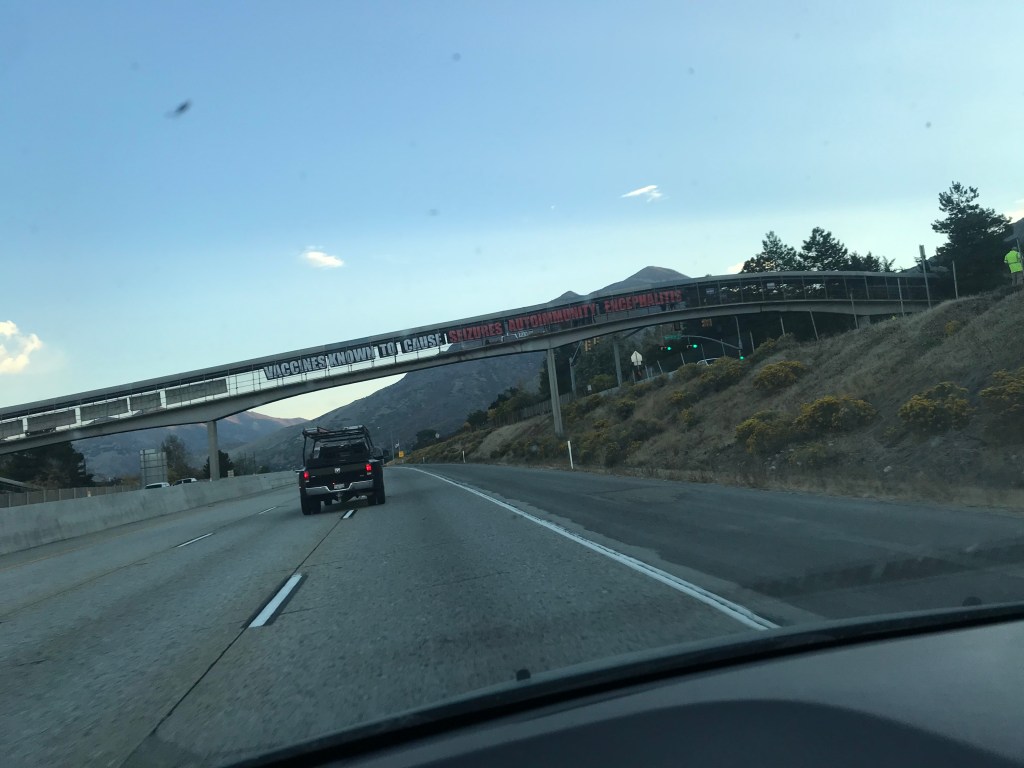
I drove past a series of banners the day after the VP debate. There were even people guarding the signs.
Let’s be clear here, there are many scientific, peer reviewed studies at this point that have debunked the myth that vaccinations cause autism.
We know that the doctor that started this rumor has been discredited and even disbarred.
And thanks to the brilliant book of Eula Biss, we know that the profile of someone who doesn’t vaccinate is someone who is affluent enough to opt out.
Fake news travels six times faster than the truth. Which is why the conspiracy theory still lives on.
The question is, does the person who makes the banner have a responsibility to ask, “What is this for?”
Capitalism dictates that if I don’t make it someone else will.
In the short run, someone else probably will print it. But is this something you can be proud of? You got paid, but money is only one unit of measure. There are other ways to measure our work.
Let’s take it a step further, who is supposed to police Facebook for false information? Facebook has done a terrible job at this point. So, is it your job to jump on and say something about fake news? What if they don’t believe you? When is the last time a tweet changed your mind anyway?
Wikipedia uses moderators. People who have volunteered and shown up again and again, proving they can exercise good judgement. But what happens when AI can do it better most of the time? Do we accept the implicit biases that come?
Bottom line is, we can demand capitalism, social media giants, (and yes, your local printers) to be better. Each of us can have the guts to make the difficult, emotional decision to do the hard work of changing people’s minds too. That is how we build a culture we can all be proud of.
Which means short-sighted, unimaginative, narrow-minded.
One of the challenges of this year is we have a hard time imagining a world where things are different again. Sometimes we call this the “new normal.”
Except things will most surely be different going forward.
The pandemic has only started to unlock the potential of video conferencing. Many will be asking when this is all over why am I going back to the office? Why spend all this money on rent? What does this mean for schools?
And we certainly can see that for too long we have made short-sighted decisions for our systems to be efficient rather than resilient. That can’t continue forever.
The thing is, we are myopic by nature. Because of the story we tell ourselves. Because we are focused on us, the here, the now.
And with sensory overload every time we turn on our phone or email or laptop to be more informed, it’s easy to say, “This is someone else’s problem or “This is too messy to clean up.”
We can’t imagine a world of new possibilities when we are stuck with the same patterns. The same choices are likely to bring the same results.
The chance then we have to take is making different choices. But different choices means change. What if it doesn’t work? Well, thats what happens when we refuse to make the difficult choice early.
Does delaying difficult decisions ever get easier the longer we wait?
In Ancient Greek, there were two words for time: Chronos and Kairos.
Chronos we are very familiar with. It is what we tend to think of time as. Something linear, like a watch.
Kairos, on the other hand, is much more difficult to translate. But it’s best to think of it as a window of opportunity, here in the moment, right now.
The thing is, our mind and body can be in two different places. And thanks to the invention of email, the internet and smart phones, we tend to be thinking about something or somewhere else rather than being present.
Yet, there is only now. Time is not borrowed, stolen, given or reserved. You can’t buy it.
That is why your attention is your most precious resource. How are you spending it?
From time to time, we get this question in the field.
And for a teen, who isn’t feeling particularly motivated by much at the moment, it can be a real challenge to see the forest through the trees. Without the experience of seeing that stories have new chapters, especially in the COVID era, why should I try so hard?
In this scenario, I usually turn it around with another question and ask, “Why did you wake up and brush your teeth this morning?”
Of course, the answer is they want to have good hygiene. And why is it important to have good hygiene? Because clean teeth enriches our lives.
Bingo.
Studies have shown that the two important factors to keeping our motivation high is achievement and praise for achievement. That’s it. When we can accomplish something (no matter how small) and are given praise for it, it motivates us to do it again.
It turns out external rewards work on the short run. When we feel stuck, we can use a carrot to get us going again. Over time, with enough achievement under our belt we can learn to create an internal narrative of, “I have done this before and I can do it again.”
Difficult for teens because they simply haven’t been alive long enough to have a history to look back on.
Parents are asking themselves, “Is this the best use of my $1,500? Is this really going to help my kid?”
Students that participate in our course show an increase of connectedness, happiness, perseverance, optimism and engagement.
The truth is, there are no secrets on what we do. All the books have been written on these subjects, all the information is right at your fingertips.
So, why is it worth it?
Because without help or guidance, it can take years to collate the information we have put together to get these results. We have carefully curated 100 books to design this class. (To put that in perspective, the average person only reads one book per year after school.)
It turns out that a CFO in a business that went under feels stuck. And so does the person who worked in one field for the last 10 years too.
Everyone feels stuck where they are at.
The good news is that anyone with a laptop and an internet connection has the same tools as Jeff Bezos.
That if you wanted, you can string together a long series of hours after work for many months and get better at learning something new.
Do it for a couple years, and you can make a living. Do it for a decade, you have a career.
That is just what the power of your choices can bring. A few hours per day. That is nothing when you consider how much time we spend wasting on our phone or binge watching Netflix.
This feeling of being stuck, most of us feel it. The question is whether you have the guts to start over. Can you stare down the pipe and lean in?
There is no guarantee that pivoting and jumping into a new gig will work. But the thing you thought would work the first time, how did that turn out?
 Josh Allred's Blog