Part 2: Who’s going to test it?

For a long time, it was widely believed that stomach ulcers were mainly caused by stress. But in 1982, Dr. Barry Marshall and Dr. Robin Warren had discovered that it was actually caused by a bacteria called Helicobacter pylori.

It was ground breaking research that could make the lives of millions better. Except…

Except, no one believed them.

Doctors carried a worldview that such a big discovery was reserved for the elite schools, not the University of Western Australia and that bacteria couldn’t live in such an acidic environment.

After years of ridicule and rejection, Dr. Barry Marshall decided to drink(!) a broth full of Helicobacter pylori, which caused a stomach ulcer. He then treated it with simple antibiotics.

When you know something to be true, it’s important to remember to be persistent long enough for others to see what you see. Sometimes, it might mean doing something that has never been done before.
Part 1: Who’s going to test it?

In 1888, Karl Benz was struggling to launch the first automobile in Europe. He needed to prove to the public that his vehicle would work. It was his wife, Bertha Benz (who financed the project to begin with), who had the guts to test it.

Bertha Benz, along with her two kids, took the Patent-Motorwagen No. 3 without her husband’s knowledge and without permission from the authorities, then illegally drove it on the first long-distance automobile road trip.

Over the next 121 miles, she had to clean the carburetor with her hat pin and used her garter to insulate a wire. Enlisted a blacksmith to fix a broken chain. She then refueled at a local pharmacy using highly volatile ligroin, making it the first fueling station in history. When the wooden brakes wore down, she asked a local cobbler to nail leather on the brake blocks, inventing the first brake pads.

Once Bertha reached her destination, she sent a telegram to Karl confirming her arrival. Her marketing campaign worked. The Benz car gained considerable attention from her adventure.

You’ll never know which projects will work until you find the courage to test them.

Much easier to test projects we believe in. But it’s easier to believe what we can imagine. The challenge then is to help others to see, to bridge the gap of what is and what could be.

Flight delays didn’t exist 200 years ago

Neither was lost luggage or lousy food service.

Because there was no air traffic to speak of.

The fact is, no matter what problem we solve (like transferring large quantities of people over great distances in a fraction of the time), the more ubiquitous technology becomes, the more we find to complain about.

It’s in our nature to focus on the negative, to find what is out-of-place. It’s part of our default setting to think about the now instead of the past and future.

It’s easy to see, once one problem is solved (flight), two more pop in its place (airports, pilots, air traffic control, security…).

It’s up to us to choose whether we see the world as half full or half empty.

When is enough, enough?

Wall Street missed its projection on Facebook this quarter. Instead of $13.4 billion in revenue, it grew $13.2. And instead of a 13% increase in user growth, Facebook came short at 11%.

As a result, Facebook shares dropped 25% in one day. But as Bob Lefsetz points out, Facebook will bounce back.

The problem wasn’t growth, clearly there was plenty of that. The problem wasn’t enough growth.

So, the question becomes When is enough, enough?

And I think part of the crux of all of this is when we can’t be satisfied with a number, the default answer is always more.

But is more money really the answer to our problems?

Is the fact you’re unhappy with the work you do, the projects you ship, going to be fixed with a larger bank account?

Does money fix your boss’s attitude? Will it fix yours?

Probably not. And neither will continuous growth. It’s easy to forget that temporary setbacks are just that—temporary.

Numbers are a lousy way to predict the uncertain future, quit putting so much confidence in them.

Vocation is more than a paycheck

Over the last century, the word vocation has been misunderstood as a job, something you do for money.

But in Latin, vocātiōn actually means a call.

Be careful choosing your life’s vocation.

You will always find those who think they know what your calling is better than you do.

They don’t.

So, quit seeking approval from everyone and do what you must.

The cosmic lottery

As Ben Carey has pointed out:

“There is 1 chance in 140 trillion that the Earth should exist. There is 1 chance in 795 billion that life should have evolved on earth. There is 1 chance in 89 billion that life should have evolved into mankind. There is 1 chance in 12 billion that mankind should have created the alphabet and thus civilization. There is 1 chance in 6 billion that your parents should ever have met and got together. There is 1 chance in 90 million that you should have been the lucky sperm that fertilized your mother’s egg…”

You’ve won the genetic lottery. You’ve beaten the odds to be here in this moment, in this time period, with all these resources, with so much extra.

Yet, we are still not happy. We are still not satisfied. We lose focus on the important and replace it with the urgent: work, bills, social media.

Life is so fragile. In fact, so fragile it’s easy to sit back and say we’ve made it this far, why rock the boat?

On the other hand…

Why stop now?

It easy to forget where we came from because it’s not easy to see. And when we forget how resilient the human spirit is to travel so far, we limit how far we can go forward.

“How long until we get there?”

Depends on how fast you want to go.

We spend most of our lives on the journey, not the destination.

Destinations are short-lived.

If we focus only on the destination, we forget to enjoy the journey along the way.

Be happy to be alive.

Closure

We see the world through our lens: what we touch, what we smell, what we see and taste and what we hear—so how can you prove anything exists outside what our senses pick up?

We can’t disprove it because it’s impossible to absorb all that the world has to offer, we have to make assumptions.

We assume the world is round, even though we’ve never traveled in space.

It’s called closure. Closure is a phenomenon of observing the parts but perceiving the whole.

And as Scott McCloud has pointed out that with comics books all the action takes place in between the panels. We use closure to fill in these gaps.

Our lives work like a comic book. All the action of who we are and what we are trying to become happens between the panels. In the end, we don’t remember every single detail of our lives but rather snapshots.

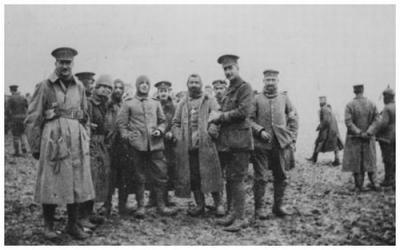
For one day

One hundred and four years ago today, World War I had begun.

The next six months that followed, millions of people would die in one of the worst conflicts in human history.

For one day, that all stopped.

The armies of France, Britain and Germany put down their weapons for a brief moment to celebrate Christmas.

Even in our darkest moments, when we are locked in our worst disputes, we can still find our humanity.

We can still choose to set aside our differences and forgive.

Christmas_Truce_1

“It’s up to you”

That’s what was written on Radiohead’s checkout screen when you went to purchase the album In Rainbows.

In 2007, during the height of music piracy, it was a radical idea to allow customers to pay whatever they wanted.

And while record sales were falling off a cliff, Radiohead survived because they understood this principle that many of us still fail to grasp:

When we feed the network, the network turns around and feeds us back.

Give instead of get.

Make instead of take.

Share instead of receive.

It’s difficult to lean back and hope that our true fans will be their to catch us. But that’s the world we have built going forward.