You are telling me that it is impossible to learn how to code or to learn how to play the guitar?
Of course not. You could learn it if you wanted to. It’s the same with riding a bike, learning how to swim, and driving a car. All skills that need to practice. And with reps, you get better.
How come then we are reluctant to make art? Why won’t we put pen to paper and write something down?
We treat our art as something that only people with talent have. But nothing can be further from the truth.
Yesterday is gone. It is not coming back. It’s a shame that the system has worked overtime to get you to believe that you are insufficient to even begin. What would be unforgivable, however, is to let the mistakes of the past haunt the opportunities of the future.
We are all entitled to our beliefs. We can choose to believe what we want to believe. We can craft stories and narratives about the world and how we see it. We can have opinions about taste and debate the merits of the policy. It is all subjective.
What we don’t get to choose is the facts.
If Earth’s temperature has risen by 0.14° Fahrenheit (0.08° Celsius) per decade since 1880, that isn’t an opinion that is a fact. Because we have data that supports the statement. We can observe and test it.
Trust the science if it is sound. Otherwise, we are just choosing our own truths instead of finding an objective one.
Trust your neighbors when they tell you the new restaurant down the street is worth a try.
How many marines wake up in the morning excited to do pushups? Not many. I don’t have a military background but I can imagine that a lot of military personnel who are not exactly friends with their drill sergeants at boot camp. So why do the push-ups if it isn’t for the boss telling you what to do?
I am sure they do it for a lot of reasons:
Duty, discipline, fitness, working as a team, chain of command…there is a deeper reason why we do the things we don’t want to do, even if that thing is good for us in the long run.
You can’t just stop eating french fries and then start eating ice cream. That doesn’t solve the problem. It isn’t enough to stop doing one behavior. You have to replace it with something-substituting the behavior with another, faking it until you make it.
There isn’t a lot of thought put into starting out to become a runner. You put on your shoes and go. It isn’t until you do this for, I don’t know, thirty days or so that you can say you are now a runner. Because you can look at your history with satisfaction.
The point is action is the key to changing behavior. It isn’t what you can’t do, it’s what you now can.
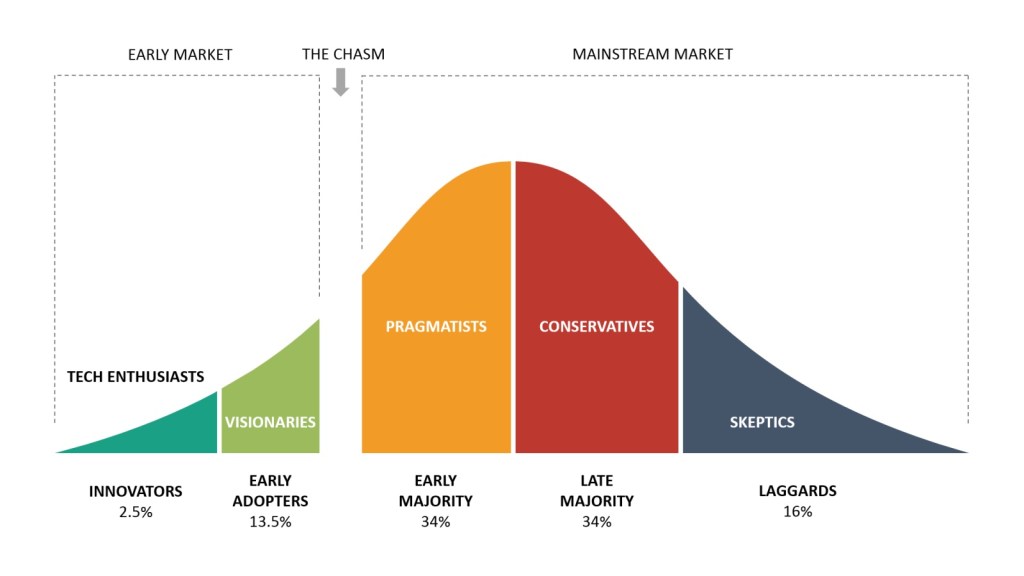
This concept is really important if you want to make change for a living. Take a look at the Bell Curve below.
Geoffrey Moore pioneered this idea in order to bring technology to the masses you have to jump the chasm to be relevant. The rest of us focus so much of our attention on trying to be something for everybody. But we end up being nothing to no one. And the reason is simple. You are not Walmart. You are not Amazon or Apple. You can’t hit the masses.
This is a good thing.
The internet has broken mass media. We think it is mass media but it is not. The internet is a micro-medium. Because once Seinfeld ended (they had 75 million people watching the final episode) you can’t buy that kind of attention anymore. Maybe the Superbowl but that is it. The internet broke the masses up because now you can find idiosyncratic tribes anywhere. If you want to find a group of underwater basket weavers, you can!
The internet breaks up large groups and segments them. Now, we go back to the smallest viable audience. You get to pick which audience to serve. Which to change.
How are you going to change a million people, if you can’t change one?
Acrobat and performing artist, Yoann Bourgeois, built a ten-step staircase next to a trampoline. And he will perform his act by showing the struggle it takes to reach the top. When you first watch, you think the point is to reach the top, and then he can stop falling but I don’t think that is what Bourgeois is saying. He reminds us that the destination isn’t the point. You reach your goal to be on top of the steps and then what?
The goal is the journey and the process. Along the way, you are going to perpetually fail over and over again. Sure, there might be satisfaction and temporary rest at the top but you will eventually have to start over again.
You are more resilient than you think you are. Life is and always will be a struggle. That is the point. It wouldn’t be life without it–it would be something else.
 Josh Allred's Blog