Where to eat next?

Here’s a beautiful tribute to the late Anthony Bordain. A two-year love project to map out all the places he ate worldwide.

I am a massive fan of Tony and was sad to see him go. Not to minimize the project, I also think he would have wanted us to go find our adventures to explore the world.

It wasn’t just about the food. It was about the people, the sounds, the smells–finding beauty and art where people just glance over.

The world is much larger than the one we create at home. If you are lucky enough to travel, you should try to eat up as much as you can.

If only we paid more attention, we could find more adventure.
“Hang up the phone”

Most teens have heard their parents say, “Hang up the phone.” But we don’t actually put the phone in the hangar anymore.

Further…

Most teenagers are surprised to discover that you used to pay per text message. 25 cents to send a message and 10 cents to receive one. You also had to click the keys multiple times to get the letter you wanted.

The point is culture changes fast. It is invisible. There are things we say and do out of habit that we don’t even hold relevance anymore. And yet, sometimes we preserve these traditions because it is the way of life we know.

The tickle monster

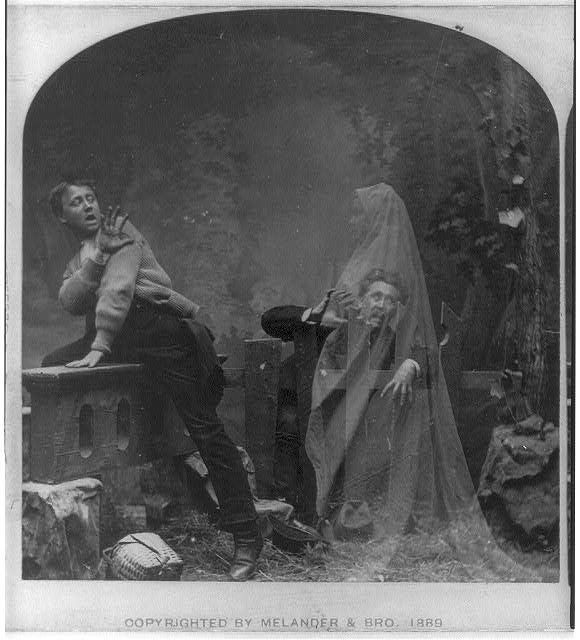
The Haunted Line is an early photograph by L.M. Melander and Brothers in 1889. It’s obviously fake. A clever illusion. An early photo shop.

It turns out though that two in five Americans believe ghosts exist.

If we were to reframe the question and ask people if they believe in a tickle monster almost everyone would laugh.

How we ask questions changes the way we respond.

A noisy world

Without interruptions, what do you think you could accomplish?

Why then do we not spend the time building a system that is more resilient to the outside world?

Few ideas:

Unsubscribe to incoming emails.

Turn off notifications on your phone.

Work where you live. Create a shorter commute.

Perhaps go on a Netflix fast.

Log out of what you want to limit your time using. The friction of logging back in can be enough from consuming time.

Close the door to your office for an hour. Ask not to be disturbed during this time. Work as hard as you can for the 60 minutes you have allotted.

Prioritize the most difficult tasks first while you have more brain power.

There are more out there. The irony, however, doesn’t escape me: How many of these interruptions do we allow in our life to distract us from what we don’t want to focus on?

With or without compromise?

Which parts of our lives do we hold so sacred and true that we no longer question them?

The reason I ask is that these things we know also influence every decision we make in life. They guide us, like a compass, in the direction we go.

Yet, many of us in a post-industrial world is left unsatisfied with where we land.

Life is a contradiction. To be able to hold two opposing ideas at the same time can be a true sign of wisdom. Yet, once we know how things are, we begin to create the world as we see it.

Nouns and verbs

When we know who we are–a CPA, a teacher or driver–then we begin a cycle of self-prophecy.

When we take a life of action–writing, skiing, leadership–then who knows what happens next?

You are not a noun. You are action-oriented.

What does it look like?

When you create something it has to follow a genre. It has to look familiar to something that has been here before. Otherwise, we don’t get it.

On the other hand…

We didn’t understand Campbell’s Soup, Fountain, and Lavender Mist at first. It broke our brains. It didn’t remind us of anything that came before.

This is rare and indeed difficult to do. You either get really lucky or learn to develop excellent taste.

The great works of art still followed some rules though. Paint still finds a way to get on a canvas.

Understanding genre, which rules to follow, which to bend and which to break will serve you well in becoming a professional in your field.

Leaving our opinions at the door

What then?

Perhaps, it is impossible not to have an opinion. Our biases and snap judgments always seem to be with us like a shadow. We can try though. And when we decide to not have an opinion about everything that is being said, when we are curious, then the door is open to learning something new.

Because what we hear doesn’t get in the way of what we think we know.

What’s left to offer?

It’s important to recognize when there is nothing left to be said.

In that moment we can begin to feel the tension in the air.

The first reaction is to say something to relieve it.

Don’t.

Instead, sit with the tension.

You can always listen.

Perhaps, the key to really good advice is to be in silence longer than we are comfortable sitting in.

The speed of reality

We are all guilty of being slow to accept a reality that is unfolding before our eyes because it is often happening faster than we expect.

We do this because we are anchored to our world in how we see it.

How we see it is informed by the stories we tell ourselves.