Smallest viable audience

This concept is really important if you want to make change for a living. Take a look at the Bell Curve below.
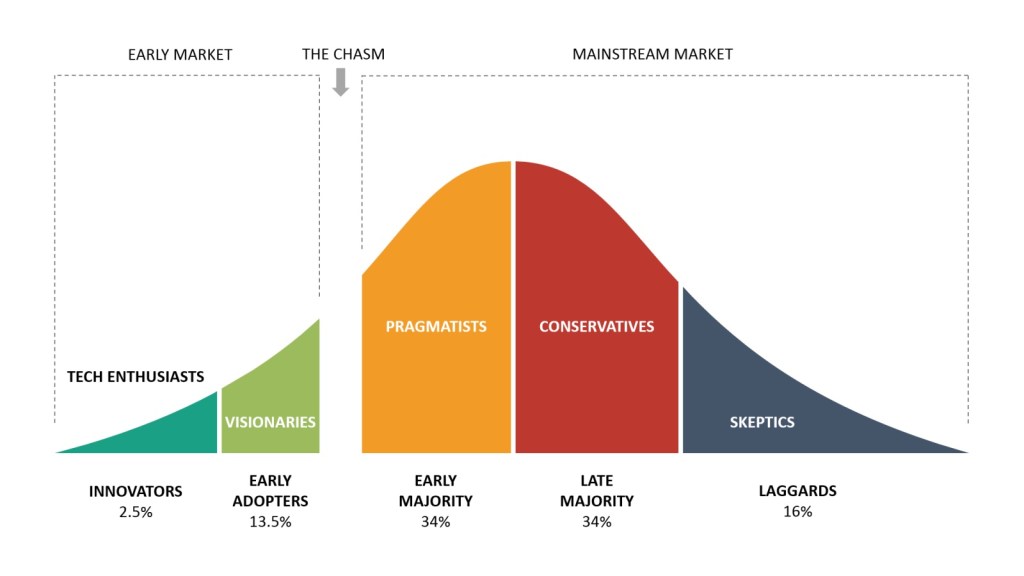
Geoffrey Moore pioneered this idea in order to bring technology to the masses you have to jump the chasm to be relevant. The rest of us focus so much of our attention on trying to be something for everybody. But we end up being nothing to no one. And the reason is simple. You are not Walmart. You are not Amazon or Apple. You can’t hit the masses.

This is a good thing.

The internet has broken mass media. We think it is mass media but it is not. The internet is a micro-medium. Because once Seinfeld ended (they had 75 million people watching the final episode) you can’t buy that kind of attention anymore. Maybe the Superbowl but that is it. The internet broke the masses up because now you can find idiosyncratic tribes anywhere. If you want to find a group of underwater basket weavers, you can!

The internet breaks up large groups and segments them. Now, we go back to the smallest viable audience. You get to pick which audience to serve. Which to change.

How are you going to change a million people, if you can’t change one?

Start small and grow from there.

About the journey

Acrobat and performing artist, Yoann Bourgeois, built a ten-step staircase next to a trampoline. And he will perform his act by showing the struggle it takes to reach the top. When you first watch, you think the point is to reach the top, and then he can stop falling but I don’t think that is what Bourgeois is saying. He reminds us that the destination isn’t the point. You reach your goal to be on top of the steps and then what?

The goal is the journey and the process. Along the way, you are going to perpetually fail over and over again. Sure, there might be satisfaction and temporary rest at the top but you will eventually have to start over again.

You are more resilient than you think you are. Life is and always will be a struggle. That is the point. It wouldn’t be life without it–it would be something else.

The way versus a way

It used to drive me crazy to get a suggestion to solve a problem once it has been decided how to solve it.

That’s because what I often hear was someone telling me how they would do it. That their way must mean it is the correct way. But there are a lot of methods to skin a cat. There’s simply a path or a choice. Sure there are choices that are more efficient. Others are shortcuts that pollute the environment or hurt people around you. There are choices that think about the bottom line and others that lead to change. And others that are simply sufficient to get things done. “This is how I have done it for years.”

Perhaps spending your time fitting a square peg into a round hole is a worthwhile endeavor if you are on the edge of solving interesting problems. Innovation only comes when we notice things that someone else doesn’t. After all, Joseph Priestly didn’t invent oxygen, he discovered it.

There is no right answer. There are many solutions to problems.

The door that Walmart can’t walk through

Don’t ship junk.

Don’t make average stuff for average people.

Don’t spam.

Don’t show up unannounced.

Don’t call from an anonymous number.

Don’t buy fake followers.

Don’t leave inauthentic reviews.

Don’t tell people their call is important and put them on hold.

Instead….

Ship the best work you can do based on the constraints.

Make something remarkable that will have people talking about it.

Ask for their email.

Invite.

Make the CEO available.

Create something relevant that has value.

Write from your heart.

And give your attention to people you seek to serve.

The post-industrial complex

In 1900, there were over 2,000 companies producing cars. And by 1929, there were only 44. What happened?

Well, Henry Ford developed the assembly line and promised his worker that if they come to the Ford factory, he will pay them five dollars a day instead of 50 cents.

Not only that, a car went from a thousand dollars in 1900 to $850 by 1908 thanks to Ford’s assembly line. By 1924, that number dropped to just 250 bucks.

That is what happens when people work together. That is what industrialism has produced and what Taylorism has perfected. We have created a world of wealth. As a side effect, stuff is now cheap and abundant.

But there are other side effects.

One of those is the indoctrination that this stuff can fill our souls. It isn’t enough to own artifacts. If we are going to find meaning in our lives, we are going to have to step out of this system and re-evaluate what it means to be human.

Because if we are going to define value by a dollar amount or who has more stuff or by a number of likes–we will never be satisfied. Even the richest people in the world lack something.

This is one of the challenges of our time.

Create a practice

It is scary to stare into the void. It freezes us because it just feels overwhelming to have so many choices. Until you create boundaries and constraints. Once you do that a whole bunch of things begin to open up.

Hence why it is critical to creating a practice.

Once you decide you are going to be vegan, you don’t then head to Outback Steakhouse for dinner.

Once you decide to become a runner, then every day you wake up and ask when am I going to run today.

Once you decide to become a writer, you are looking for something to write every day.

You won’t be stuck deciding to go or not. You already had the meeting and made the decision. The question isn’t whether to go or not. Instead, you get to decide if you want to go right or left but you are going.

Faking it until you make it

No one goes to bed, closes their eyes, and then instantly falls asleep. Instead, you fake it. You fake it until one moment you are awake and the next you are sleeping.

Most of the time, especially creators and artists, feel like a fraud. We often don’t feel like we are in the mood to do our best work.

The alternative is to build a practice. Faking it until you make it. Every day, I sit down to write a blog but it doesn’t mean every day I feel in the mood. On those days, I fake it. I write bad writing until something is worthy of publishing. The best I can do that day.

Build your life around a practice. And when you do, you will soon discover that what you do determines way more how you feel rather than how you feel determines what you do.

Paid for

For thousands of years, people made music because they wanted to. They made music because they could.

This is a modern notion that our art needs to be paid. To be clear: I am not saying artists shouldn’t get paid, they should.

What I am saying is no one owes you anything for doing something that brings joy and meaning to your life. No one owes you a living to share with them something that you are proud of.

Yes, we want a connection. The artist brings together the tribe. But that can also be separate from making a living to pay the rent. We have confused this idea if it doesn’t get paid, then it must not have value. That is so far from the truth. Because what’s good is subjective. What’s good is about taste. And just cause someone gets paid doesn’t mean they automatically are better.

The reason I bring this up is that the paycheck hangs us up so much from ever starting something. It is a trap of comparison.

Do it because you love it.

One answer to regret

If I were to do it all over again, I would have learned how to play guitar at an earlier age.

I picked it up as a senior in high school, and unfortunately, didn’t keep practicing with it after a few years. That was almost twenty years ago. Imagine if I would have stuck with it, how good would I be today?

I continue to make the same mistake when I regret not learning how to play the guitar instead of actually practicing.

The lesson here is this: Don’t make the same mistakes today as you did yesterday. The key to moving on from regret is action. Start doing that thing you always wanted to do.

Raising your hand

It’s funny when a presentation ends and everyone dismisses, you leave to start your car, and all of a sudden you thought of a really good question you wished you would have asked.

That’s because the pressure is off. No one is sitting next to you. No one is there to judge you. There is no risk or exposure.

Of course, there is no chance for anyone to be better informed or better connected because you didn’t have the guts to think of a question in the first place.

A lot of work is done behind the scenes when no one is watching. But also there is the work that is essential when everyone is. We need to have the guts to stand up and say what we believe in. You will always be judged, regardless of what you do.