A little bigger

Es Devlin didn’t design stages for Kanye West or U2 or Beyonce because she applied on Indeed.com. No, she was sought after because of her reputation. Because of her body of work.

How did she develop this type of following? How does anyone become a stage designer for the biggest acts in the world?

Like all of us, she started small. Eventually, she won an award and got some recognition for the incredible, generous work. She built trust and attention with every interaction.

And then, she got to do it again. Over time, a little bigger.

You don’t apply for your dream job, you create it.

Authenticity is overrated

Great designers understand that being completely authentic isn’t the experience most of us are looking for.

The magic of Charlie Brown wasn’t that the drawings were life-like or that you could hear everything the parents said.

No, Charles Schulz left enough room for interpretation and imagination. He gave us enough of a framework to connect. The magic was the rudimentary drawings and the muffled sounds.

The work you do doesn’t have to be perfect. It just needs to be honest.

The Platinum Rule

Recently, a dear friend of mine sent this thoughtful email:

Hey Josh,

I wondered if I could get your thoughts on something. This is something that has been weighing on my mind lately and I’m trying to get a grasp on my thoughts. After hearing some of your comments today I feel that you will have great thoughts on this topic.

Each day it seems the world gets harder and harder. People around us each day are going through struggles, struggling with depression, feeling anxious, getting addicted to things, making bad decisions or just simply get lazy. I often ask myself “How can I help prevent this in the lives of those around me?” or “What can I do to positively impact those around me?” – I’ve gotten one glaring, overwhelming answer:

“Learn how to build a deeper connection with the people around you.”

If we truly want to make a difference in someone’s life we need to understand how to effectively build a connection with them. We are all different. We communicate in different ways, we think using different processes, our minds process things differently, our emotions are all different – so if I truly want to make a difference I need to understand how to communicate with different types of people.

The Platinum Rule

There is a widely known “golden rule” which we all know – “Treat others how you want to be treated.” This is a great rule to live by. It promotes kindness and love towards others. But I’ve recently learned something known as “The Platinum Rule” which states – “Treat others the way they want to be treated.” Let me expound:

If I treated everyone how I want to be treated, I would walk around all day telling people how great they are, cracking jokes, having light conversation and enjoying groups of people (which is usually what I do). That is how I would want others to treat me. However, that may not be how S wants to be treated. S may want more one-on-one interaction with deep conversation and less “fluff.” I treat him how I want to be treated it will likely not build a connection and may even result in a bad relationship between S and myself. If I truly want to build a connection with S, I need to be able to understand how to communicate at his level, then be dynamic enough to communicate that way.

Another example – I have two children. I love them both more than I could ever explain. One day W will start to make his own important choices. As I watch him progress and learn I will need to understand how to effectively communicate with him. Does he react well to discipline? Does he need to be talked to calmly? Does he need to have things broken down for him into structured lessons? Does he need me to motivate him? Does he want me to preach to him or listen to him? etc. The way I interact with W will surely have to be different from how I interact with M. But if I want to build a deep connection with them and make a difference in their lives I will need to understand who they are and how they respond to different communication styles.

The following matrix (that I tried to explain today) is used to group people into 4 personality groups. This has been useful for me to understand people’s personalities and how they may want to be “treated.”
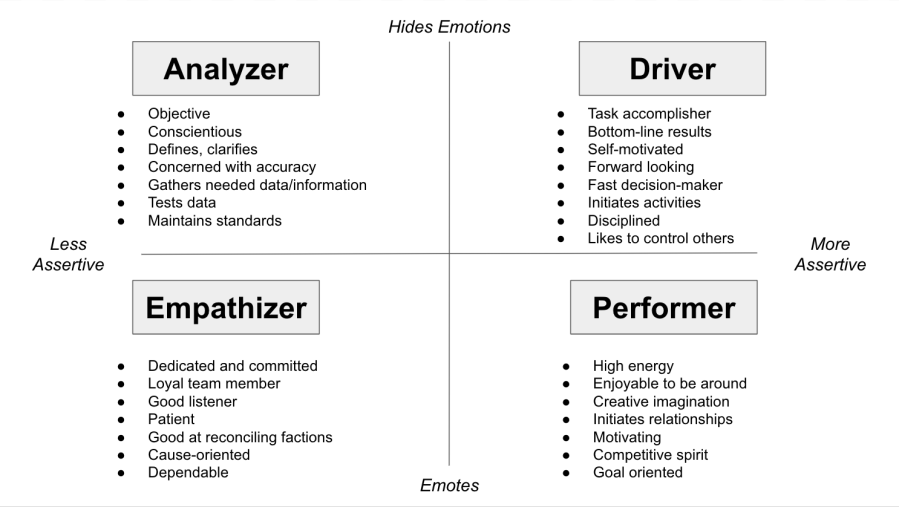
Screen Shot 2018-08-26 at 9.30.26 PM

My question for you is two-fold:
How can we build a meaningful connection with the people we care about?
How can we better adapt our communication to fit the needs of each individual person?

I’d love to hear your thoughts.

First off, the Platinum rule is a much better rule to follow. Our most important resources we can offer others is trust and attention. Marketers (and I would argue someone who posts a cat video on YouTube is a marketer) are working overtime to steal these resources. It varies but we are exposed to over 60,000 advertisements a day. Of course, not all marketers are selfish. Good marketers help us tell better stories.

Every one of us has a worldview, an internal dialogue on how we see the world, the story we tell ourselves. Aligning someone’s story with ours is the challenge of our day. If a bunch of people were to witness a car crash, everyone would report seeing something different. Why? Because of the story we tell ourselves. We see what we want to see, while ignoring the rest.

Everyone is right. We’re right because if you were raised the way someone else was raised, was taught they were taught, you would probably act the same way. We’re right because we look for things to reinforce our worldview, not to change it.

So how do you change people’s mind? Stories are what stick. That’s why parables from the Bible have lasted after 2,000 years or why Aesop’s fables stick with us because of the universal message.

The way our brains operate is based on fear. There are two nuclei attached to our spinal cord called the amygdala. That fight or flight response can react two seconds before our neocortex kicks in. The interesting thing inside the limbic system is that it has no capacity for language. This is where the chemicals in our brains make decisions. The neocortex is trying to interpret these chemicals. In other words, this narrative has nothing to do with our decision-making. And yet, we spend so much time bargaining with this narration.

Another way to look at this is if you’re watching a football play: the QB throws the ball, the receiver catches it and the announcer says, “he catches the pass”…imagine for a moment that the announcer says, “he catches the pass” and then the player does it. That would be really cool. Of course, it doesn’t work that way. When we are arguing with this narrative, it’s like arguing with the play-by-play announcer. He doesn’t have any control of the play, he’s just narrating.

(Think about this for a minute. It’s a game changer.)

What’s kept us alive for thousands of years is this fight or flight response. Now, we don’t run away from saber tooth tigers anymore, but that is how our brain continues to operate. When we hear a tree branch snap or receive a text from our boss, our brain reacts the same way in fear. If the fear is not going away, we need to learn to dance with it. When we talk about helping people get from where they are to where it is they want to go, understand that we all act in a way that keeps us safe. This is why we avoid emotional risks. We’ve seen this with the challenge of becoming more self-reliant. There are those that rather stick with what they know (debt) because that’s what they are familiar with. Change means “this might not work.” If I change my status-quo, I would I have to admit I have been wrong this whole time. We can help bridge this gap by helping others see, “knowing what I know now, I can make this shift.”

I can go on about our opportunity to become a torch bearer, the role artists play, debt/economics, gift economies, loon noises…but this would turn into a book that I hope to write someday.

“Step into my office”

Platon is one of the most important photographers of this generation.

Even if you are unfamiliar with his name, it’s more than likely that you’re familiar with his work. He’s famous for getting close-ups of his subjects, so close that you can see their pores.

Platon has to work around these world leaders schedules, leaving very little time with them. Sometimes, he has to meet in less than ideal places, like backstage or in a tucked away room.

So, how does he get big personalities to open up, to show another side of themselves?

First, Platon invites people into his “office,” a white sheet set up and an old white crate for people to sit on. The way he explains it, everyone sits on the crate. Sometimes at the dismay of security guards, everyone eventually sits.

Platon doesn’t have something you don’t. He carries a white sheet, a white crate and a camera. The magic is his story:

That crate has had more world leaders sit on it than any other seat in the world.

That’s a story. Maybe even a right of passage.

We focus so much on the tools and tactics, we forget to craft a better story. “Step into my office” is supposed to relax people, to displace them. Of course, it’s ridiculous to ask the President of the United States to sit on an old white crate, but that’s what you do when you work with Platon.

There may be others out there who can take better portrait shots but none of them crafted a story like Platon. Craft and prefect your story and you will never run out of work.

If only we jumped a little higher

If you were to place a slew of fleas in a jar and sealed it, the fleas will hit the top trying to escape.

After a while though, the fleas will train themselves to jump just below the ceiling. At that point, you can remove the lid and the fleas won’t escape.

Human beings live the exact same way.

After a while of hitting our ceiling, we get discouraged, we quit jumping so high. We just accept our environment and call it “the way things are.”

It’s difficult to see when your environment changes. Sure, it’s discouraging while you wait for things to move, but what’s the alternative?

The way things are, are not the way things will always be.

What will you choose to shed your light on?

Lewis Hine chose to use his camera for social reform. At a time when child labor made up 20% of the workforce, his pictures helped spur a movement that changed how we saw our children. Not as cogs in a machine but as human beings.

That same opportunity lies before each of us.

You have a camera, a microphone, a keyboard and channels for distribution—all the means of production right at your fingertips—what more do you need?

You can say or do anything you want. You can choose to write a post about what you had for lunch or contribute to work that matters.

So, how are you going to use this opportunity?

Are you shedding light in dark places or are you sitting on the sidelines complaining about the weather?

You choose what to amplify.

“There is work that profits children, and there is work that brings profit only to employers. The object of employing children is not to train them, but to get high profits from their work.” — Lewis Hine, 1908

Generosity leads to self-reliance

It’s a common misconception that we must become self-reliant before we can be generous.

It’s really the other way around.

Generosity leads to more self-reliance.

Self-reliance doesn’t necessarily lead to more generosity. It certainly can, but it is unlikely that someone who is greedy in nature wakes up one morning and starts giving his money or talents generously away.

Money and status and resources can amplify our efforts, but it doesn’t dictate character.

That’s the problem with survival of the fittest mentality, the dog eat dog world—we view the world as fixed, that someone receiving a bigger portion must mean that I received less.

The world is infinite in possibilities and there is plenty for everyone to go around.

When we fight for every inch, for every penny, we lose a part of ourselves that many of us are seeking in all of this, our humanity.

When we develop this posture of enough, enough resources, enough to share, that generosity spreads.

When we take care of others first, the tribe wants to help us in return. It has been said for thousands of years: The more you give, the more you get.

What Newton’s Third Law failed to mention

With every action, there’s an equal and opposite reaction.

No point in trying to argue with the data. It has been scientifically proven that there are invisible forces in this world working against us.

So, when we try to take control of our lives, when we attempt to do something that has never been done before to create forward motion, it’ll be met with an equal and opposing force.

That force is Resistance.

Resistance is the voice in our head that keeps us from being the person we’re born to be. It comes in the form of shame or guilt. It comes in more subtle forms of distraction like Facebook or Netflix binge watching. Or it can be in your face addiction.

Resistance is responsible for more misery and more suffering than any other entity known to human kind.

Resistance is like gravity. There is no use in trying to make it go away. Instead, we can use it as a compass. As we take a step forward, and see Resistance ramp up, we can know that we are on the right track of something great and daring and wonderful.

Don’t stop. Keep moving forward.

Follow through isn’t a planning problem

The typical executive will spend 23 hours a week in meetings.

Seems like we use 80% of our time identify and discussing problems, leaving only 20% to fix them.

It’s clear, we spend far too much time discussing how to solve problems, instead of playing active roles to solve them.

It’s another form of hiding.

What if instead, we spent 80% of our time creating forward motion? How much more could you accomplish?

It’s really underrated to find someone who will just go and not wait what to be told what to do next.

This could be you. And it’s extremely valuable in a labor force that is stuck waiting to be shown what to do next.