Perhaps happiness isn’t the goal.
Perhaps the goal should be…the pursuit of feeling complete.
Because perfect isn’t the absence of suffering but the embrace of it.
Perhaps happiness isn’t the goal.
Perhaps the goal should be…the pursuit of feeling complete.
Because perfect isn’t the absence of suffering but the embrace of it.
A few might think it’s a good idea to take advantage of someone, but that isn’t you. Yet we see it out in the wild with MLM scams, the world of influencers, sports gambling, algorithms, and so on.
Just because there’s a market doesn’t mean we should take advantage. What’s making money without a moral compass to guide us?
Singing in the shower is much easier since no one is watching. It is free-flowing, and no one judges us if we get something wrong. That pressure to perform can transport us.
Indeed, the tree can’t make a sound if there is no one to hear it. Perhaps your work should stay private because it’s not for them. But if we can’t ever show our work, then there is no chance to ever delight anyone.
Compromising to making spec, under budget, and on time might feel like it is killing the artist vision.
Sometimes, we get to choose to do art. But usually, we have to choose to do the work of a professional. Show up and do the work. Keep the promise we made.
Freedom from constraints is often a seductive route. But sometimes, our best work is done under deadlines and with guardrails.
Make some magic out of this thing. Go.
Emerson wrote, and it kicked off the Transcendentalist movement. Kerouac started the Beats. Thompson invented a whole new style of journalism.
None of them applied for these positions on Indeed. The movement didn’t show up until the writers gathered to make something happen. Even then, no one can possibly know the impact they are going to make on the world—until you make the thing.
The Internet can still be a magical place—a place to be surprised, a place of wonder. However, what matters more than ever is our intent to use these tools. (Without guardrails, they begin to use us.)
If we go there to confirm our bias, we will find it. If we want to be entertained or to escape, we can do that too. But when we are open to learning, we can still be surprised to discover how much is out there ready to be consumed by the attentive student.
Three pieces worth checking out:
Seth Godin’s Blog: “Be yourself”
The Ezra Klein Show: “Our kids are the least flourishing generation we know.”
Cory Doctorow: Schismogenesis
I think about the amount of friction we have reduced in our lives. Much of it in a good way. (Soon, there won’t be a need to fill out TPS reports, and AI will take care of it.) But when we seek to remove friction in relationships, we will create a world that pushes further into isolation. The path forward isn’t one click away, but the “road less traveled” is full of surprises and inconveniences. Not because it is easy. But precisely, that is what makes us better humans.
People confuse what poverty is. We think it means a lack of means: money and possessions. Yet, by all accounts, the world’s most primitive people today have the fewest possessions. But they are not poor.
Because poverty is a social construct—a modern-day invention. In gift societies, there was not a surplus of items. You made due. You shared. You gave gifts. And we still found ways to get by, even thrive.
Poverty is a symptom of our modern-day world. The most straightforward example is that the world produces enough food to feed everyone 1.5 times over. And yet, one in 10 people goes to bed hungry every night. While things are improving, we also see what happens when we create social status, which has accelerated in modern times.
Jacqueline Novogratz has a much better take on what poverty is: “The opposite of poverty isn’t wealth, but dignity.” She describes it as having a choice, agency, the opportunity to contribute, and to be seen. This has nothing to do with money. As the wise Bob Marley once said, “Some people are so poor, all they have is money.”
“It was not until culture neared the height of its material achievements that it erected a shrine to the Unattainable: Infinite Needs.”
I’ve been reading Marshall Sahlins’ essential book, Stone Age Economics, where Sahlins teaches us that neolithic societies were built on sharing, mobilization, and resource diversification rather than storage, ownership, and wealth accumulation.
Today, in our modern comforts, it is easy to put our noses up to such ways of being. But it isn’t weird; it is just different. In fact, when the argument can be made that hunter-gathers worked less hard and therefore had higher qualities of life (doing the things we profess to want to do/what we believe work enables: spend time with spouse, play catch with your kid, learn, leisure/recreation activities, etc.), it is a bit of counter-intuitive to what we have been brain washed to believe. No one in their right mind would want to go back. That’s fair to say when you count for modern technology such as toilets, clean water coming out of the tap, antiseptics, and so on. But this is the wrong question. A better one is to understand how they lived. If we took the modern comforts and subtracted our disease for more, what then? What if there was a middle way?
I happen to also be reading Waldon by Henry David Thoreau. I’ll leave this to ponder:
“Our life is frittered away by detail. Simplify, simplify, simplify! I say, let your affairs be as two or three, and not a hundred or a thousand; instead of a million count half a dozen, and keep your accounts on your thumb-nail.”
One of the challenges I see with getting off social media is that it can feel risky to stop.
What if I miss out?
What if I am left behind?
When something feels this risky (to quit), sometimes all we need is a nudge. For someone to say it’s okay to move on. “Follow me.”
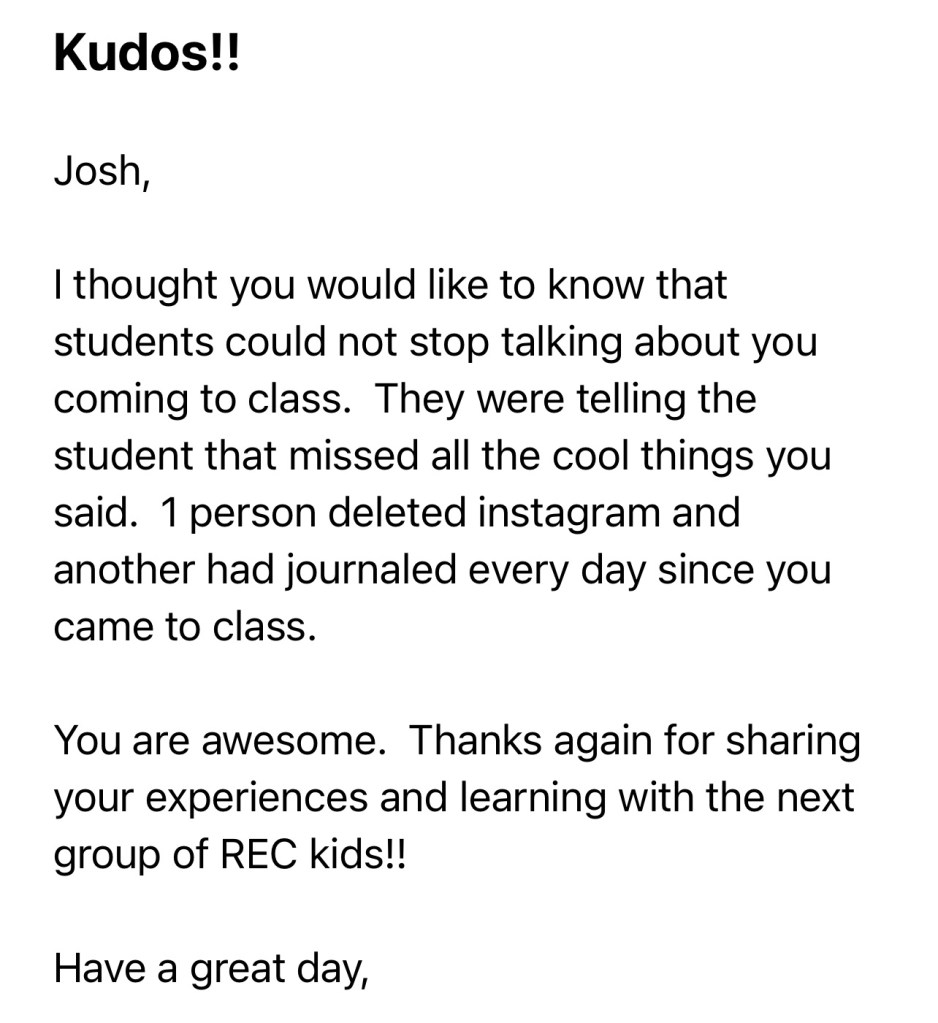
Last week, I had the opportunity to speak with eight Seniors at my old college. While I wasn’t planning on going to these spaces, we talked about making better decisions. What we can do with our time and efforts. How to make art.
And this was the email I got back:
It is easier to find a rhythm when we have a beat to follow.
Nothing is worse than a human who has abandoned hope.
Hope doesn’t abandon us. We abandon it.

