Poverty better defined

People confuse what poverty is. We think it means a lack of means: money and possessions. Yet, by all accounts, the world’s most primitive people today have the fewest possessions. But they are not poor.

Because poverty is a social construct—a modern-day invention. In gift societies, there was not a surplus of items. You made due. You shared. You gave gifts. And we still found ways to get by, even thrive.

Poverty is a symptom of our modern-day world. The most straightforward example is that the world produces enough food to feed everyone 1.5 times over. And yet, one in 10 people goes to bed hungry every night. While things are improving, we also see what happens when we create social status, which has accelerated in modern times.

Jacqueline Novogratz has a much better take on what poverty is: “The opposite of poverty isn’t wealth, but dignity.” She describes it as having a choice, agency, the opportunity to contribute, and to be seen. This has nothing to do with money. As the wise Bob Marley once said, “Some people are so poor, all they have is money.”
Simplify, simplify, simplify

“It was not until culture neared the height of its material achievements that it erected a shrine to the Unattainable: Infinite Needs.”

I’ve been reading Marshall Sahlins’ essential book, Stone Age Economics, where Sahlins teaches us that neolithic societies were built on sharing, mobilization, and resource diversification rather than storage, ownership, and wealth accumulation.

Today, in our modern comforts, it is easy to put our noses up to such ways of being. But it isn’t weird; it is just different. In fact, when the argument can be made that hunter-gathers worked less hard and therefore had higher qualities of life (doing the things we profess to want to do/what we believe work enables: spend time with spouse, play catch with your kid, learn, leisure/recreation activities, etc.), it is a bit of counter-intuitive to what we have been brain washed to believe. No one in their right mind would want to go back. That’s fair to say when you count for modern technology such as toilets, clean water coming out of the tap, antiseptics, and so on. But this is the wrong question. A better one is to understand how they lived. If we took the modern comforts and subtracted our disease for more, what then? What if there was a middle way?

I happen to also be reading Waldon by Henry David Thoreau. I’ll leave this to ponder:

“Our life is frittered away by detail. Simplify, simplify, simplify! I say, let your affairs be as two or three, and not a hundred or a thousand; instead of a million count half a dozen, and keep your accounts on your thumb-nail.”

“Follow me.”

One of the challenges I see with getting off social media is that it can feel risky to stop.

What if I miss out?

What if I am left behind?

When something feels this risky (to quit), sometimes all we need is a nudge. For someone to say it’s okay to move on. “Follow me.”

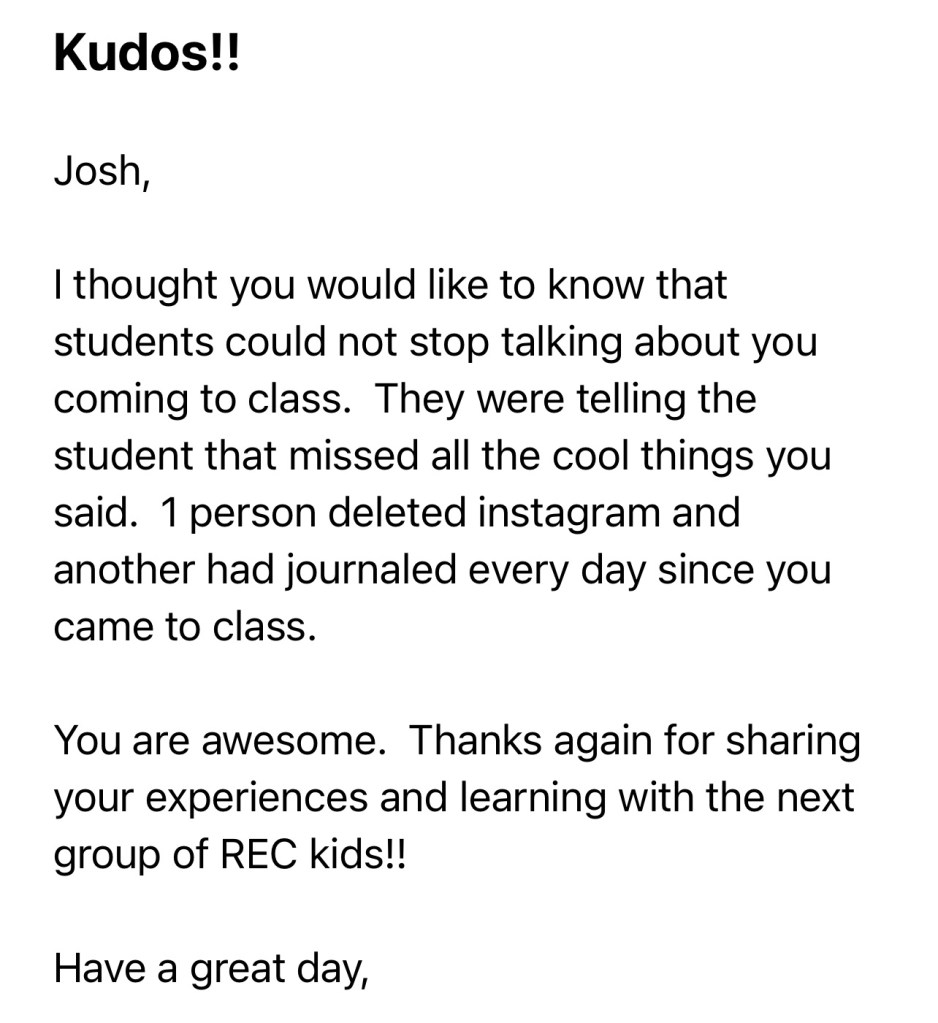
Last week, I had the opportunity to speak with eight Seniors at my old college. While I wasn’t planning on going to these spaces, we talked about making better decisions. What we can do with our time and efforts. How to make art.

And this was the email I got back:

It is easier to find a rhythm when we have a beat to follow.

Pressure

Pressure implies constant force on an object.

Shooting free throws when the game is on the line teaches us how to manage this pressure.

Instant pots use pressure to cook food.

In other words, not all pressure is bad.

However…

Pressure to do something we are uncomfortable with might open up doors.

Jumping the high dive when all our friends just did it might push us out of our comfort zones.

Getting picked to give a presentation to the board of directors may not be your thing, but your colleagues believe you can do it.

Getting the encouragement to ask a girl to dance, a friend can apply pressure to muster the courage.

Pressure to do something reckless or dangerous, however, isn’t something we want to do.

The way to manage peer pressure is to become really good at assessing the risk.

Is this a real danger? Or is it perceived? Peers are good at pushing us out of our comfort zones, but they can also take it too far when there are no brakes.

In the end, peer pressure creates tension and friction. And can test a relationship.

Still

Writers like Proust, Joyce, and Kerouac are masters at seeing things everyone else tends to overlook. When we slow down and actually process what we are watching before our eyes, we then can find the words. The words matter. They teach us that we can find beauty in everyday life. You don’t need to be in an exotic location (although it helps), but even then, we can become complacent and take for granted how beautiful this world is. The reason? Our modern world has conditioned us to move on to the next thing.

Public speaking tip

Giving a presentation to an entire school can be nerve-racking, but talking one-on-one with your best friend is free-flowing. At what number is public speaking too much? More than one? Five? Ten? 100? What’s the difference? The difference is that anytime we speak up, we fear being judged. But you can’t possibly please everyone in the crowd. Even if that crowd is made of one.

Public speaking is an art form. However, some of the best public speakers were not good at talking. And what we say is not nearly as important as what we do. The same advice can be said with writing–write like you talk. And with public speaking–talk like you talk.

You have plenty of practice sounding like you, not trying to sound like someone else.

Speaking up

A friend recently experienced a traumatic event in which someone in their party was caught in an avalanche. Luckily, no one was hurt other than their egos. If you know anything about snow science, people are their own worst enemies. Most avalanches are triggered by humans.

This has reminded me that sometimes, it is about having the conviction and the constitution to say the quiet part out loud. We massively underestimate what our voice can do. But when the time comes to stand up and use it, we often shrink. It isn’t the popular thing to say. It will threaten your status. It can feel risky. But important is rarely popular.

Systems, culture, and games

Systems, culture, and games are all around us. Understanding the key characteristics is important for navigating an ever-changing, complex world.

Systems are formal structures that allow people to adopt particular behaviors in order to operate. For instance, an education system in which a teacher must teach students to memorize when The War of 1812 was to ace a test isn’t the same as teaching students how to learn a subject. Modern-day systems push people to optimize metrics (to be faster/cheaper with fewer defects), follow instructions, and focus on appearances rather than substance. Systems often ignore culture and create tension for those who operate in it.

Culture is “people like us do things like this.” It is a shared set of beliefs, values, rituals, customs, symbols, and artifacts. These are the invisible rules and norms. You don’t show up at the golf course in blue jeans and a T-shirt. That’s not how things are done around here. Culture pushes us to fit in, not stand out, be mediocre, and follow the masses.

(It is worth mentioning here that status plays a role in everything we do. It enables culture. Who’s up? Who’s down? Caste systems thrive because humans categorize (wrongly) other humans and use false proxies to put someone above another.)

Games are either finite or infinite. Finite games have rules, boundaries, winners, losers, and a designated time. We are very familiar with finite games like soccer. But racing to submit TPS reports before Friday at 5 so you can go home on time is another type of game. Infinite games are different in that you play the game to keep playing. When I play catch with a six-year-old, I am not playing to “win”; instead, I toss the ball to entice the six-year-old to throw it back. Humans are biologically wired to play games. Games are much better when you are not set up to lose. Understanding how debt systems work, for instance, and making a game out of it, mixing in the rules and making your own, is a good way to stay out of debt to enable other games–like doing your art.

Hidden costs

Costs are hidden with money, time, and attention. Here are some of the costs we tend to overlook:

The costs of maintenance: Buying a boat seems like a good idea until you realize that renting one is better. Boats need to be maintained and stored in order to work. Upkeep, storage, fuel, time, and energy are rarely a factor on the exciting first day of any purchase.

The cost of space: Buying a bigger home means you’ll need to fill it with more furniture.

The cost of opportunity: Owning a phone means dealing with the dopamine machine. When we trade for convenience, we must also acknowledge that we are selling it for attention that could be used to do something else.

The emotional toll: Work, produce, consume has been the industrial model for two centuries. Driving us toward debt or making purchases we don’t want to make. If we are not careful, the things we own can come to own us.