Bending the arc

In Utah, it’s possible for parents to opt out of Black History lessons. I’m speechless. Here’s just a few reasons why learning about Black History is essential for kids, particularly those who are white:

  • The United States history with slavery being legal is longer than its history being illegal. (Next year will be the first time that isn’t true.)
  • It was completely legal for a white person to own another human being. There was no escaping. No where to go. No where to hide.
  • Why didn’t settlers enslave indigenous people? It was because Africans were more resistant to European diseases and they were more familiar with the crops like sugar and tobacco. So instead of enslaving indigenous people white settlers drove them out of their home or killed them.
  • The United States built their entire economic foundation on slavery. This cruel practice is the reason why the US would eventually become the richest country in the world.
  • Adolf Hitler built the Nuremberg Laws, the centerpiece of anti-semitic legislation, using Jim Crowe Laws as a model.
  • Lynching postcards became so popular that in 1908 that the US Postal Service had to censor them. Of course, that didn’t stop people from putting them in an envelope!
  • Americans went as far as to try to prove scientifically that whites were a superior race through eugenics and the bell curve.

And we can fast forward just a little bit to find redlining, voter suppression, discrepancy of mandatory sentencing for crack and cocaine use, private prison pipeline…This is only scratching the surface.

Slavery isn’t just some unfortunate dark period in history. This was 250 years of evil. That is 12 generations!

The ability to opt out means you are in a position of power. That is privilege. Understanding how we got here is the essential first step for us to understand where it is we want to go. How else do you build a culture that we can all be proud of?

“I do not pretend to understand the moral universe; the arc is a long one, my eye reaches but little ways; I cannot calculate the curve and complete the figure by the experience of sight; I can divine it by conscience. And from what I see I am sure it bends towards justice” – Theodore Parker

HT Caste
Road biking

I’m not a road biker. But from my limited experience and what I have observed: Someone who rides their bike on the weekend is more mindful of the other road bikers when they are driving to work Monday morning.

They don’t follow them too closely, they make sure to give them plenty of space on the shoulder as they pass. They are more empathetic and tuned in to the the needs of that individual on the side of the road.

And the same goes for someone who is struggling with an addiction, going through a divorce or speaking in front of a crowd. When we have walked the path, it is much easier to walk in someone else’s shoes.

As much as we would like to believe that no one else knows what we are going through, that simply isn’t true. Thanks to the internet, we each have the opportunity to find the others. Each of us has gone through something and it may be worth exploring these areas as a place to contribute.

Grounded

Recently, a student of ours broke into what seemed like a panic attack after falling on cross-country skis. After working through many objections this student found the courage to continue forward.

Once calm I had the student go down to the snow to practice standing up. But we didn’t get up right away. Instead we introduced ourselves to the snow. Felt the snow with our gloves. Put our face to it. Became present with our surroundings. Recognizing this same snow we are scared of is the same snow we can have fun on too.

Fear won’t ever go away. But we can also look at it in the eye and learn to dance with it. It enables us to do our best work and be our best selves.

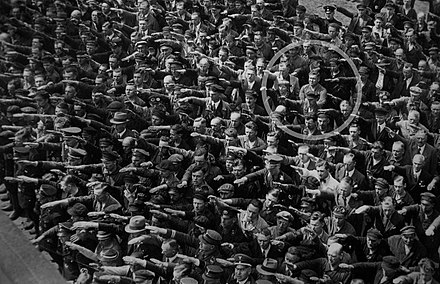
No words needed

August Landmesser, 1936

But I will say a few anyway.

Like many young men at the time struggling to find employment, August Landmesser joined the Nazi Party in 1931 in hopes for a better future. However, by 1935, he became engaged to a jewish woman named Irma Eckler. The relationship was illegal and as a result he was expelled from the party.

This is a photo of August Landmesser taken in 1936. Seeing what is going on he defies the feeling in the moment. Pushing back agains the current. By 1937, Landmesser was arrested for “dishonoring the race.” He was eventually arrested again, and was sent to a concentration camp.

During that time, Eckler was then arrested. She had their second baby while detained. She was then sent from one concentration camp to the next until 1942 where she was murdered.

This is a tragic story. How could human beings do this to one another?

That kind of bravery of Landmesser, standing up for what is right, is the kind of bravery we are missing in our culture today. We need you to stand up and to push back against a system of injustice. An invisible caste system that keeps others down because of the color of their skin. To push back towards people around around us that fall into the trap of fake news.

Here’s the thing, the world can feel like it is in a spiral, and yet, good things are done every day. People are not inherently good or bad, they are just people. People that make choices, tell stories to justify those decisions, until they wake up one day defined by those decisions.

Yet, a moment of love, compassion, and courage, can spark a person. To help them see that they are more than what they were raised to believe. They can push back against the status quo.

No one knows the path that leads us back to God.

The road is rough ahead

It’s difficult to become educated and even more difficult to live a without education.

Hard to become fit and even harder to be obese.

And the same is true about debt, marriage, parenting, owning a business…you name it.

Each path we choose will be demanding.

Perhaps, living a life without action is even more arduous.

How much material do you have?

When asked to speak at the podium for 20-minutes, do you actually have 20-minutes of good material you can use?

It’s the same for musicians, comedians, magicians, anyone who wants to perform needs a good set.

Your job is to change someone’s emotions. Every minute on stage is precious. Don’t waste their attention by stretching your time slot.

People are there to see a good show. Not a mediocre one.

Florida is drowning

Miami in particular is in trouble. Sitting at only 6 feet above sea level. It is estimated by 2100, the ocean will rise by 8 feet.

The question is why are people still developing and buying luxury condos in an area that will be underwater in the next 80 years or so?

Because of the story we tell ourselves. A story of scarcity. The status beach front property brings. The story that we are not a statistic. The story of ignoring the consequences of tomorrow. The difficulty of ignoring sunk costs.

We can’t say we weren’t informed. 80% of people in Florida already believe climate change is occurring.

Perhaps, people have faith that a solution will present itself. Or maybe they just don’t believe in the science. Others might be just enjoying the time that is left.

Each of our narratives are so powerful that it’s easy to justify any decision we make despite the presence of conflicts of interests. That narrative is there to protect us. Yet, sea levels don’t care about our stories. Delaying difficult decisions only make them more difficult.

Traps of education

There is a clear distinction between education and learning.

Education is the idea of going to an institution for a piece of paper to send a signal to future employers that you are competent at what it is you do. You can be safe, predictable and reliable in a world of uncertainty.

Learning, on the other hand, is totally different. Learning is the process of going from of place of competence to temporarily becoming incompetent. Creating tension and then working to release it once we see how something works.

Too much education is as dangerous as too little education. No one is arguing that we don’t want a brain surgeon to operate on us who didn’t finish med school.

Yet, when markets deregulate and focus on efficiency over resiliency, a six inch snow storm in Texas can have major consequences. Because the power grid couldn’t keep up with the demand at least 80 people died.

Make no mistake, this isn’t the the work of ignorance but of the educated.

Education isn’t learning.

“Form follows function”

Industrialism and the Civil War moved us from the fields to the factories. The production of steel moved us from factories to skyscrapers. As skyscrapers began to pop up everywhere at the beginning of the 20th century, the question we had failed to ask ourselves was How should it look?

That question was later answered by Louis H. Sullivan in his 1896 landmark paper, The Tall Office Building Artistically Considered. Sullivan exclaimed, “Form follows function.” It’s the idea that the exterior design of a skyscraper should also reflect the interior function.

It was revolutionary at the time. We had moved from utility to function to form. When designing something we now needed to consider the aesthetic, physiological repercussions and cultural elements while also balancing what is practical.

This waive sparked the movement of modern architecture. An avante-garde movement. Full of radical, experimental architecture. The key being that if it’s experimental then it might not work.

Here’s the problem. “This might not work” isn’t compatible with industrialism that is seeking safety, reliability and as close to a sure thing as we can get. So instead of hiring architects to build something that is remarkable to the eye, we skimp and cut corners to meet spec. We create buildings that look the same as everything else. Something proven. Something that blends in.

In a world that is pulling us to do something reliable, in order to stand out from the masses, we have to be peculiar, different, unusual. Yes, good architecture still has to rhyme with the genre. It still needs a budget and boundaries to work within. But those constraints help us explore the edges. To make something worth standing and looking at.

Art evokes emotions. It brings connection in a generous way. Architecture changes the way we see our world. When we walk into a building, we have an expectation. Which leads us back to the question we faced 100 years ago, What do we want to see when we interact with the world?

Do we want to live in a world that is built on efficiency or perhaps something else?

When you lay your eyes on the Grand Canyon for the first time, no one sits there and thinks about its function. We admire its magnificence because of its form. Why shouldn’t we treat the rest of our environment with this kind of care?

Garbage day

The first piece of dirty laundry on the floor, the first weed to grow, the first piece of trash left on the sidewalk, it’s easy to notice that something is out of place. It’s also a problem with an easy fix. Piece by piece, over time, you develop a mess.

It’s easy to tell what kind of problems we don’t like to solve by the messes we leave.

If you find yourself submitting taxes at the deadline, have a cluttered inbox, or find having a discussion around carbon emissions excruciating–you have a reaction problem. You are reacting to the situation instead of initiating the solution.

If there is something that you don’t look forward to doing, make it a priority to do it first. Delaying problems that we don’t want to deal with, doesn’t make us more motivated to solve them later.