Story-driven

Human beings are irrational creatures. This is why fake back surgery is also as successful as real ones. Or why cheap wine can taste as good as the expensive stuff when blindfolded. We can trick ourselves into believing anything. We can double think, believe in two contradicting/opposing views at the same time. Believe that Princess Diana died and is still alive today. We can read 99 5-star reviews about our work but get down about the one person who didn’t like it. We struggle as tensions build in a conversation–especially when the conversation is around us and things we can’t change. We can ignore science and believe in things we can’t see.

Humans are story-driven. We cherry-pick the information and plant it into a story we are already telling ourselves about the world. None of us are rational, regardless of whether we think we are the exception.
Navigating or creating

Sailors use charts to figure out where it is they want to go. And for most of us, life can feel like navigation. Trying to get through the day with as little inconvenience or pain as possible. Finding the easy path through challenges. Getting from Point A to Point B as fast as possible.

The problem is, this isn’t the only way to live our life. After all, when our time is up, we all end up in the same place. Instead of trying to navigate through life, we can work on creating the life we always imagined is a much better approach.

We can be deliberate in defining what a life of joy or success looks like. For some, it might be money. But that will only take you so far and is really only one silly way to measure.

Imagine the life you want to create, and go out and do it.

Semiotics

Semiotics is the study of signs and symbols and how we interpret them. As humans, this is how we can interpret a world with limited information. Driving down the street, I might not know this neighbor but I can tell something about them if they are flying a Gadsden or a transgender flag. These are signals we are sending to the world for others to interpret. We are letting people know who we are and what we are standing for.

Of course, this isn’t just flags but the clothes we wear, the food we eat, the team we root for, the vehicle we drive, whether we choose to wear a mask or not. All signals we are sending to formulate a story we are telling ourselves of how we see the world and the story we are telling others.

A moment of grace

When someone has made an egregious error that is not the time to abandon them. Especially when they are in the middle of a shame cycle.

Holding onto that tension to stay in the room with them, that is extending grace.

Grace is divine.

“Don’t double-dip the chip!”

There are invisible rules we have all agreed upon to maintain the status quo. Many of these rules are here for good reason. We don’t want to eat someone else’s saliva. The trick is understanding which rules are meant to be enforced, bent or broken. Indeed, culture is one of the most powerful forces steering our lives. It’s in the air we breathe, we can’t even recognize it. The very clothes you wear, the language you speak, the way you talk/walk/eat, the food you make, the car you drive, the content you consume, the joke you make, the things you buy…all influenced by the culture.

It is worth pondering how the status quo has held you back from living the life you have always imagined? Because those rules may need to be bent or perhaps shattered.

Searching for meaning

Surveys show that most people believe they control their own destiny. What the data also shows is that the majority of people also believe that everything happens for a reason.

A contradiction. We believe we are in the driver’s seat but we also believe in fate.

That’s simply a narration we have of ourselves and the world around us. We have to create meaning in the struggle otherwise we struggle to create meaning.

Burton boards

In 1977, Jake Burton founded Burton Snowboards. This was a really difficult time to be manufacturing snowboards since most resorts banned riding sideways.

But Jake Burton kept persisting. He worked with local ski resorts to open their lifts to snowboards and finally in 1982, the Suicide Six ski area in Pomfret, Vermont, became the first mountain to allow snowboarders. Not long after Stratton Mountain, Jay Peak, and Stowe resort all opened up their slopes to boarders.

Here is the part that is interesting to me. At first, no one allowed snowboarders. Once it happened gradually, then it was suddenly you can ride everywhere. And once it was accepted at your local resort, other riders were curious to try too.

Because of their hard work bringing the sport to the public, Burton became one of the leading manufacturers of snowboards today.

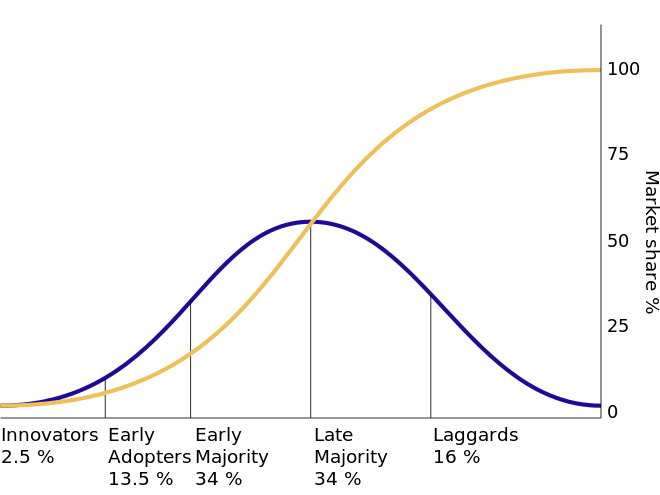
Your ideas take time to adopt. Not everyone embraces your ideas, especially at the beginning. Even today, there are three resorts that still don’t allow snowboarding (two in Utah).

As Everett Rogers points out, you have your early adopters who will embrace the new and the laggards who are refusing to change.

The story we tell ourselves about certainty and miracles

We have a difficult time believing a human amputee can regenerate a missing limb. It’s because we don’t observe this in nature. Humans just haven’t been able to do this (yet) even if we see it with Salamanders.

On the other hand, it’s much easier to have faith that someone can cure cancer without the assistance of science because, in some extremely rare cases, it’s happened.

A couple of things: What we can detect and understand changes the story we tell ourselves. Yet, we quite often put our faith in processes without fully understanding how things work. And sometimes, we throw out the science to tell ourselves a completely different story that narrowly defies the laws of nature.