“Nature versus nurture” is a term so ingrained into our language when talking about the upbringing of children to why people behave the way they do.
It turns out, that phrase was coined by Francis Galton, the father of the pseudoscience of eugenics.
We mirror our behaviors from the people that have come before us. Most of the time, without even knowing. When we hear phrases like “In this economy?” or “ballpark figure”–what are we really saying? More importantly, who are we copying?
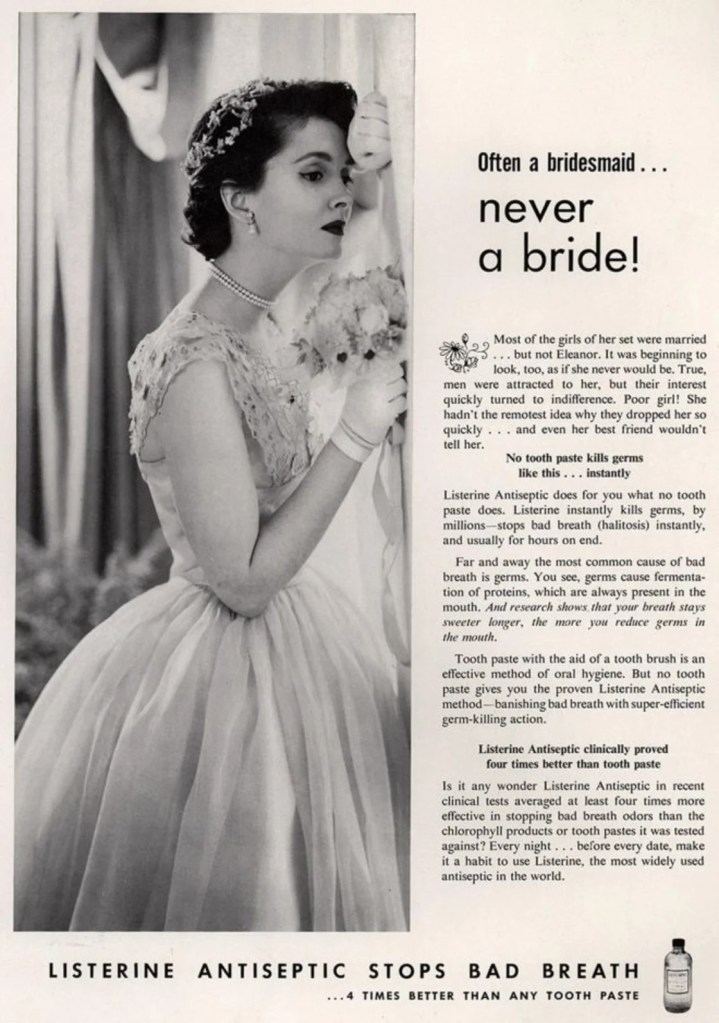
Oddly enough the phrase originated from a 1925 Listerine ad. The big selling point was how this antibacterial product can help women with halitosis (bad breath) get a man. There were two cultural phenomena happening during this period.
1) An emphasis on cleanliness. In fact, taking baths was seen as unnecessary for most of human history. Many believed it could lead to getting sick. But that changed as we moved to cities and bleach became a more widely available product.
2) As Betty Friedan pointed out in her essential book, The Feminine Mystique, women moved to the workforce during the war and after were asked to go home. During that time period, women were indoctrinated to find meaning in their lives as caregivers and were treated as second-class citizens.
It had me thinking about why is Utah last in the country in terms of women’s rights. I’m not suggesting that an advertisement in 1925 that it led to it. I am saying that when you tell a story long enough, loud enough we can begin to confuse fact with fiction.
One of the reasons why humans are such unique creatures is because of our ability to cooperate. But often that cooperation cannot sustain long enough to confront a crisis of large scale.
When we throw our hands in the air and give up, that mistake in judgment drives a feedback loop that makes a crisis louder.
Clarity loses itself in the noise. Taking a step back may be the prudent move before advancing forward. But often players will begin to find a way forward on their own. What probably should happen instead is to do the hard thing and reach across the aisle.
This is truly rock bottom. When no emergencies happening is a good day. What a difficult way to measure one’s life. (We have all been there.)
The opposite is also true: The absence of a positive. What you likely need is a break. Hang in there because light does find a way at the end of tunnels.
“Fighting the good fight” can feel like sweeping leaves in the wind. It just doesn’t feel like there is progress made despite our best efforts. The worst part is when we don’t see any improvements, even slight incremental ones, we can begin to believe there is something wrong with us. Which is unlikely to be true. Sure, there might be more things you can do, and you can change tactics but if you are in the space of creating change you are looking for those opportunities to do so. The world is a difficult, complex space to operate in, your effort doesn’t have to be always the thing in question.
It’s clear that even in its early stage Chat GPT will likely ruin lazy content creating.
While GPT could write this very blog post, GPT doesn’t understand why it would write a blog post to begin with.
The reason is the transfer of emotion.
It’s possible that a Tweet might do that but it isn’t likely. And the same can be said about a piece of art from Dall-E 2. But more often, a transfer of emotion begins with the story each of us tells ourselves about the world. AI while an important tool doesn’t move us the way a human can.
 Josh Allred's Blog