Doubt

“Ubi dubium ibi libertas.”

(“Where there is doubt, there is freedom.”)

— Latin Proverb

We have built so much of our world on habits. To create predictable outcomes. Doubt opens the door of possibility. Doubt also creates tension. We build the culture to solve this, thinking it can go away. But it possibly can’t.

The alternative to create this tension, embrace it, and lean into it.

Paradoxes broken down

Paradoxes can be broken down into three categories:

  1. Vertical paradox means truthful or not illusionary. Problems that seem paradoxical. For example, take the Birthday Paradox. If you were to survey 40 people, some people would likely share a birthday. While an interesting phenomenon, it isn’t a paradox in nature.
  2. Falsidical paradox establishes a result that not only appears false but actually is false. A classic example of this is Zeno’s Paradox. Let’s say to get from Point A to Point B is 10 feet. I start walking halfway; I am now 5 feet from my destination. Then I go halfway again, so now I am 2.5 feet. Then again, halfway, now I am 1.25 feet. Then again, 0.625 feet away. Then again, and so on. I can never reach my destination because every time I move, I must arrive at the halfway stage before I arrive at the destination. It’s a paradox. It broke the brains of mathematicians for a long time until the limits of calculous were discovered.
  3. The antinomy paradox is a fundamental paradox. An excellent example of an antinomy paradox is the Liar’s Paradox, which states, “This sentence is false.” So, for this sentence to be true, it also must be false. And if it is false, then it must be true. Which means it is a contradiction. And we are stuck in a loop. The antinomy paradox is a fundamental paradox. An excellent example of an antinomy paradox is the Liar’s Paradox, which states, “This sentence is false.” So, for this sentence to be true, it also must be false. And if it is false, then it must be true. Which means it is a contradiction. And we are stuck in a loop. Another example of this is The Barber’s Paradox, first proposed by mathematician Bertrand Russell. It goes like this: The only barber in the village declared that he shaved everyone in the village who did not shave himself. So, here is the question, “Who shaves the barber?” If he does not shave himself, then he is one of those in the village who does not shave himself, and so is shaved by the barber, namely, himself. If he shaves himself, he is, of course, one of the people in the village who the barber does not shave. It’s a contradiction.  

Natural law

The laws of legal fiction do not bind us because they are not natural law. It exists only in our imagination and if we can agree upon it. And so, to break the loop, we don’t stay in the loop or use the same rules. We can step out of it, examine it, and come to a different conclusion. 

Strange loops

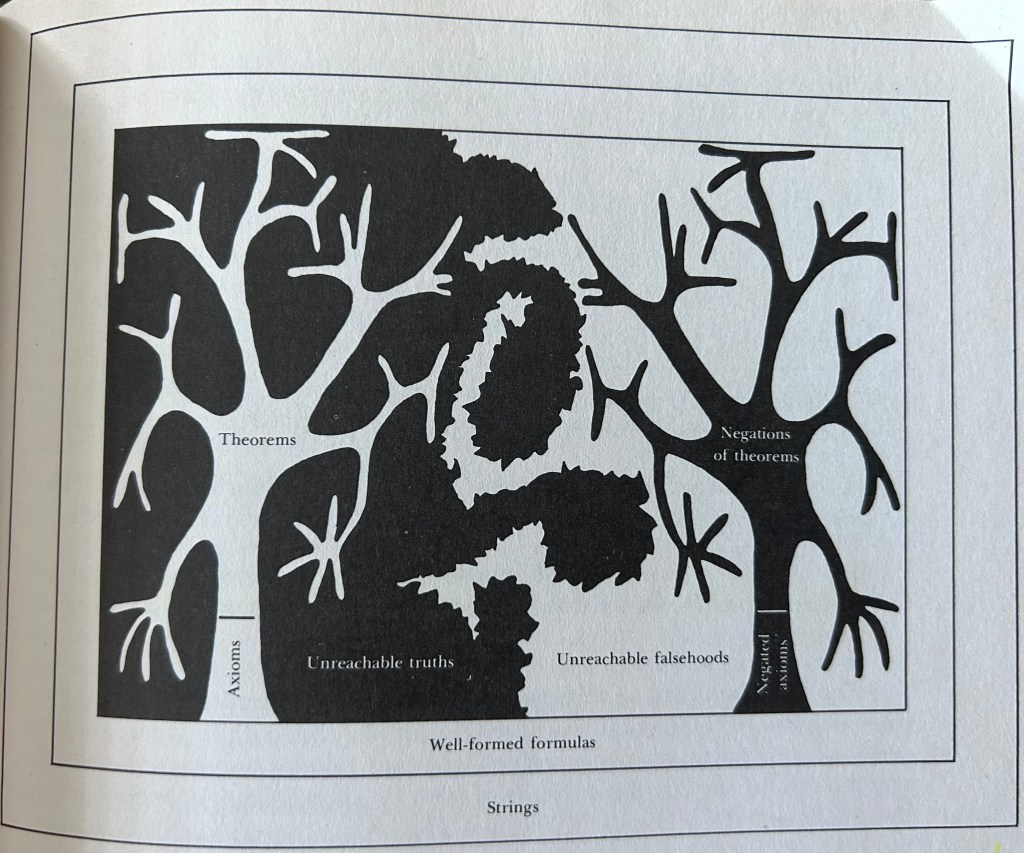
As Douglas Hofstdader demonstrated in GEB, there are these “strange loops” where a structure goes through several levels in a hierarchical system that, by moving upwards or downwards through the system, one finds oneself back where one started. (A paradox.) And how these properties of self-referential systems can be used to describe the unique properties of the mind. We don’t want to struggle for an indeterminate, possibly infinite length of time to determine if some string is an axiom. 

The limits of knowledge

We are made up of the inanimate organic material, yet we come to a self in this. It’s beautiful when you think about it. But trying to explain it is trying to prove a paradox. We can pick an axiom and devise a bunch of theorems to prove that train of thought. But eventually, we reach the limits of these axioms. Humans don’t need to be locked into that train of thought. And so, we step outside only to step into the next set of assumptions. There are unreachable truths, unreachable falsehoods. With every theorem, we can prove there is a negation of it. With every axiom, there is a counter place to start. 

A supernova

A supernova explosion is so large that we struggle to find the words to describe it.

That’s because our brains can’t comprehend the vastness of space.

I believe, as a result, it is why we focus so much on the small.

It can make us petty, but even worse, we tend to focus on ourselves and how we feel.

Often times when we are struggling, it is the range of focus–and we could use a recalibration.

Chasing the ideal

The paradox of choice states that the more choices we have, the more unhappy we feel.

The reason?

It’s the trap of comparison, which states that when making a choice, we are less happy about the decision we made because when caught looking through this lens we imagine what we could have experienced.

In other words, we need a choice but too many overwhelms our pyschology. And we must learn to be happy about the choices instead of getting caught up in the ideal.

It is that chase in the ideal that makes us so miserable.

The Streetlight Effect

Observational bias is a trap people fall into when they only search for something where it is easiest to look. There is this old joke called the Streetlight Effect, or Drunkard’s Search Principle, that demonstrates this. It goes something like this: 

A policeman sees a drunk man searching for something under a streetlight and asks what the drunk lost. He says that he lost his keys, so they both look under the streetlight together. After a few minutes, the policeman asks if he is sure he lost them here, and the drunk replies no and that he lost them in the park. The policeman asks why he is searching here, and the drunk replies, “This is where the light is.” 

It might be easier to solve the problems of where the light shines. The first step is facing the problems right at the edge of our understanding. Right where the light ends, and the darkness begins. Perhaps then, we must find the courage to take a step into this unknown and let the light follow. And if we can do it once, we can do it again. If we keep moving a little further, maybe we will get to the park where we can face the real human problems of our world. 

Spaceship Earth

So, let’s put to work our lens and pick two axioms. The first is the concept of Spaceship Earth. The earliest known use of the term is in a passage in Henry George’s published work in 1879 called Progress and Poverty. George writes, 

”It is a well-provisioned ship, this on which we sail through space. If the bread and beef above decks seem to grow scarce, we but open a hatch and there is a new supply, of which before we never dreamed. And very great command over the services of others comes to those who, as the hatches are opened, are permitted to say, “This is mine!”

It suits as a powerful framework that encourages people to remember that life is fragile in the universe, so we should act as harmonious crew members working toward the greater good as this spaceship we call Earth drifts through outer space. This planet, with how it is positioned in our solar system, sustains life, and our future survival is dependent on this ship working. And never forget that outside this spaceship, the universe is unhabitable. 
Competition

Competition is a highly regarded feature in our industrial world. The problem is most of us don’t stop to ask why? Sure there are economic reasons but more important it is the inherent bias of money that drives this behavior. We could choose different default settings. One where dignity is in the center. When do we move from this scarce mindset? Do we truly not have enough?