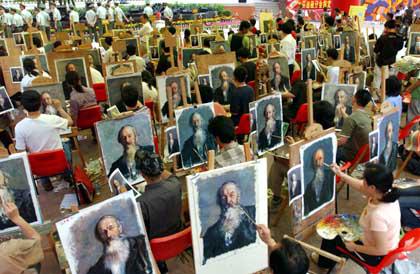
Dafen

Dafen is a village in China where it is estimated that three-quarters of the world’s oil paintings are produced. If you go there, you will see rows and rows of painters painting the same picture as they did the day before. This isn’t art; this is the industrial act of putting paint on a canvas. 

Who makes the art? No one knows. Are they technically proficient? Of course. But art is anything we do as humans that brings emotional labor to the table to make connections. And while we can fool ourselves into this this is art, painting the same thing over and over again with no defects, with no chance for failure–that is industrialism. No humanity, no chance for failure, no art.

Knocker Upper

Where does the notion of being on someone else’s time come from? It’s quite an unusual phenomenon. For most of human history, time wasn’t a unit of measure. Sure, farmers had seasons to track and a sundial could get you approximate estimates but never precise. To measure the time something took you needed to compare it to something that everyone understood. You can say it the time takes to reach the other side of town by comparing how long it takes to milk a cow or to cook dinner.

One of the greatest challenges to manufacturing production was assembling the masses to show up at the same place at the same time. After all, it didn’t help the assembly line move efficiently if the person at the front was absent delaying the person down the line. Amplifying the problem. You needed factory workers to show up, on time to begin their shift or the whole system could be delayed. The meager pocket watch became a valuable tool. 

Before watches were affordable and accurate, you had people whose job was to march the streets and to go around and wake people up. They were called Knocker Uppers, respectively. Knocker Uppers sometimes used Snuffer Outers, long pole that was used for lighting street lamps to tap on the windows of their clients until they woke up. A famous innovator, Mary Smith, used a pea shooter in 1933. 

We forget how much has changed as this profession was around until the 1940s and 50s. Time became a commodity. No longer did anyone measure distance by saying it is down the road and it’ll take 4 bowls of rice to get there. Now, you can measure precisely when and where something is. Time was not something we got but what we gave

Meaning and work

There is strong evolutionary evidence that humans developed to naturally want to work.

This makes sense when you think about it.

The way our hand’s developed to hold tools, the way our brains out wired for curiosity. You can also look at what happens to humans, that become isolated with nothing to do—they go insane.

The question then is what type of work?

The type of work with a factory doesn’t give us meaning. And so, it’s this combination of meaning and purpose that drives our work.

We don’t get disgusted at the work ahead when the meaning is important enough.

Result driven

Achievement doesn’t matter. What matters is effort. When we praise high achievement then there are winners and losers. When we praise effort then we see contributions, we see an arc, we see a journey and not a destination. We create co-dependency relationship when we seek validation. When the awards and accolades don’t come, we think there is something wrong with me. It’s getting harder and harder to compete. Only one first place, only one Nobel. But the warriors journey is long and wide open.

A concept

A concept is something we can point to but not touch.

Democracy is a concept. Debt is a concept. An LLC is a concept.

Ideas that we have all agreed upon that now exist but only in the minds of those with the shared vision.

It’s fugazi. No atoms or molecules. It survives only in our minds.

Caring class

20% of the workforce is part of the caring labor class. These jobs historically were held by women. And largely, left behind. Something that those in power, particularly men, thought it was invisible.

That’s because caring is not measured on a spreadsheet. It isn’t quantified or measured with yields. It one human connecting with another.

As AI continues to replace jobs, many of those who think about the bottom line will start trying to make AI replace what only humans can do.

People care about the story. They care about intent. They don’t need another algorithm.

Debt came before money

One common misconception from a historical perspective is thinking about money as some sort of means of exchange used to make bartering easier. We have all heard the story of the neighbor who came over and wanted to buy your cow for 3 goats, but you didn’t want goats so money was introduced as this way to bypass awkward bartering. But what archeology has shown is that there is no evidence in history where this happened. In fact, debt actually came way before money. The first piece of evidence for this is on clay tablets as far back as 2,400 BC Mesopotamia. During the reign of Hammourabi, for instance, there were elaborate debt-keeping systems on tablets that would be destroyed on a periodic basis to wipe the slate clean.

Coins, on the other hand, didn’t start popping up until about 600 BC when major armies were stationed. If you think about it, it makes a lot of sense why this is. If you have an army of say 10,000 soldiers, one of the biggest challenges is figuring out how to feed them. Food that is walking distance of the camp would all be depleted rather quickly, and it would take thousands of people to shuttle the food to the soldiers. It just isn’t a very efficient way to run an army. So, kings eventually figured out that they could take prisoners of conquerers to the mine shafts, dig out pieces of gold and silver, stamp their face on it, voila you have money. You tell the rest of the conquers that you will spare their lives and in exchange you will circulate this money and collect taxes to help finance the war. Historically, not everyone paid taxes, only the conquered. Meanwhile, you pay your soldiers with coins which then can purchase food in the local area and you now have solved the problem of feeding your army.

It’s hard for us to wrap our brains around but imaginary money has been around a long time.

Morality and debt

In Sanskrit, Hebrew, and Aramaic, ‘debt,’ ‘guilt,’ and ‘sin’ are actually all the same word. There is this concept of a cosmic debt that must be paid to the gods. You are born, you now owe your life to the gods, and so you pay this debt back through worship and obedience. We can see this in the Bible with the Lord’s Prayer. In the Anglican translation it reads, “And forgeve us our trespaces, as wee forgeve them that trespasse agaynst us.” But in the original Aramaic, the John Wycliffe version, that was published 160 years prior it reads, “And forgiv us oure dettis, as we forgiven oure dettours.”

All throughout human history there is this repeated pattern that people have fallen and that grace will come to save them. What’s divine and a common narrative in all this, however, isn’t paying back the debts (Because how can one pay back a cosmic debt?) but the forgiveness of debts. Debts, however over a period of time, eventually spiral out of control. So you must have some kind of period of reconciliation. Rulers and kings would cancel debts periodically, the most famous example being The Jubilee in Israel where debts were forgiven, slaves were freed, and the people were shown God’s mercy.

As debts systems continue to spiral one can’t help but think is there some kind of cancellation ahead?

The dreadful fate of Madagascar’s citizens

In 1896, France conquered Madagascar and as most conquers do to help finance an expensive war, they spare the lives of the people and say you owe us a debt. In short, France issues Francs, creates a market, and collects taxes. What’s interesting to note here is during this same time France outlaws slavery but turns around and places a crippling debt on Madagascar. That debt carries through the next century.  It wasn’t until 1990 that France finally canceled the 698 million dollars still “owed” to them. Imagine for a moment paying in the present day to a country that conquered you 100 years prior. Unfortunately, this happened all the time in history and still continues today. 

It doesn’t stop there. During the 1950s and throughout the next several decades that followed, there were major pushes to eradicate malaria in Africa. Madagascar being crippled in debt couldn’t pay for these types of abatement and eradication programs and so they borrowed money from the World Bank and the International Monetary Fund (IMF).  In 1957, it seemed for a moment that it could work out. It was reported that malaria transmission had been reduced to such a low level that it was no longer a significant public health problem. But as control relaxed in the 1960s, there was an uptick in cases. The international economic downturn of the 1970s, further made the debt crisis even worse for Madagascar. Incomes on the island had dropped by approximately 40 percent. Outbreaks began occurring more frequently and by the mid-1980’s it was estimated that 15,000 people were dying every year during the worst four-year period of the outbreaks from a totally preventable disease. Why? Because Madagascar had a responsibility to pay its debts, it couldn’t save its people. 

Thanks to the efforts of groups like Debt Justice (formally Jubilee Debt Coalition) in 2004, The World Bank and the IMF canceled half of Madagascar’s debt. Madagascar’s total external debt at the time stood at over 4 billion US dollars. Unfortunately, it was too little, too late. People died unnecessarily. 

How money actually works

Here’s a simple example of how banks, money, and economics work. Let’s say, Richie Rich starts a bank. At the same time, Bob the Builder finishes his first big job and receives a payment of 1 million dollars. He now takes that large sum of cash in a briefcase to Richie Rich’s bank and makes a deposit. The bank now has 1 million dollars.

Next, an experienced chef, Tony B, wants to open a restaurant down the road. Tony B doesn’t have enough money to build one so he goes to see Richie Rich about a loan. Richie Rich decided it was a good investment and issued 1 million dollars by crediting his account with that sum. 

Tony B then happens to contract Bob the Builder to build the restaurant. Bob’s price is 1 million dollars. Once the job is done, Tony B writes a check to Bob who then takes that check back to Richie Rich’s bank. 

So how much money does Bob the Builder have? 2 million dollars. But how much money is in the bank’s safe? Yep, 1 million dollars.

And the bank doesn’t stop there. Richie Rich can repeat this process again. Let’s say that Tony B wants to make the restaurant twice as big and Bob the Builder says he needs an extra million. So, the process happens again and now Bob the Builder now has 3 million dollars when the job is done. The bank, well it still has 1 million dollars. 

Current US bank laws permit the bank to repeat these steps up to 10 times. In this example, Bob could have up to 10 million while the bank only has 1 million in cash which means that up to 90% of the money in the bank isn’t actually covered. It is our sole trust in an imaginary future, a promise that the whole system relies on. It’s really quite incredible when you think about it.