“Form follows function”

Industrialism and the Civil War moved us from the fields to the factories. The production of steel moved us from factories to skyscrapers. As skyscrapers began to pop up everywhere at the beginning of the 20th century, the question we had failed to ask ourselves was How should it look?

That question was later answered by Louis H. Sullivan in his 1896 landmark paper, The Tall Office Building Artistically Considered. Sullivan exclaimed, “Form follows function.” It’s the idea that the exterior design of a skyscraper should also reflect the interior function.

It was revolutionary at the time. We had moved from utility to function to form. When designing something we now needed to consider the aesthetic, physiological repercussions and cultural elements while also balancing what is practical.

This waive sparked the movement of modern architecture. An avante-garde movement. Full of radical, experimental architecture. The key being that if it’s experimental then it might not work.

Here’s the problem. “This might not work” isn’t compatible with industrialism that is seeking safety, reliability and as close to a sure thing as we can get. So instead of hiring architects to build something that is remarkable to the eye, we skimp and cut corners to meet spec. We create buildings that look the same as everything else. Something proven. Something that blends in.

In a world that is pulling us to do something reliable, in order to stand out from the masses, we have to be peculiar, different, unusual. Yes, good architecture still has to rhyme with the genre. It still needs a budget and boundaries to work within. But those constraints help us explore the edges. To make something worth standing and looking at.

Art evokes emotions. It brings connection in a generous way. Architecture changes the way we see our world. When we walk into a building, we have an expectation. Which leads us back to the question we faced 100 years ago, What do we want to see when we interact with the world?

Do we want to live in a world that is built on efficiency or perhaps something else?

When you lay your eyes on the Grand Canyon for the first time, no one sits there and thinks about its function. We admire its magnificence because of its form. Why shouldn’t we treat the rest of our environment with this kind of care?
Garbage day

The first piece of dirty laundry on the floor, the first weed to grow, the first piece of trash left on the sidewalk, it’s easy to notice that something is out of place. It’s also a problem with an easy fix. Piece by piece, over time, you develop a mess.

It’s easy to tell what kind of problems we don’t like to solve by the messes we leave.

If you find yourself submitting taxes at the deadline, have a cluttered inbox, or find having a discussion around carbon emissions excruciating–you have a reaction problem. You are reacting to the situation instead of initiating the solution.

If there is something that you don’t look forward to doing, make it a priority to do it first. Delaying problems that we don’t want to deal with, doesn’t make us more motivated to solve them later.

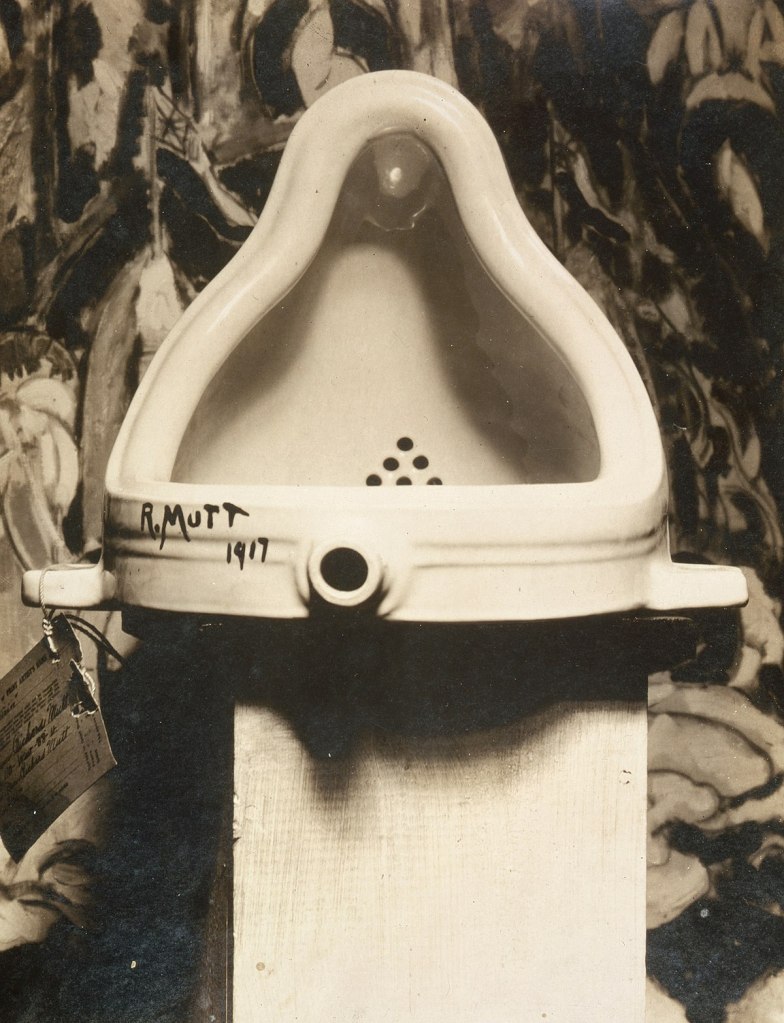
R. Mutt

Fountain created by Elsa Hildegard Baroness von Freytag-Loringhoven

In 1917, Marcell Duchamp submitted Fountain to the Society of Independent Artists exhibition. At the time, it was seen as so outrageous that it wasn’t even shown on the floor. I mean how could anyone submit a urinal and call it art?

Of course, art is more than just paint on a canvas. Today, Fountain is looked back on as one of the most important pieces of the 20th century. Because it expanded our definition of what we thought of as art.

Art is anything we do that brings emotional labor to the table to make a connection.

Which means if this urinal is art so is the plumber who figures out how to solve a difficult problem and to delight a customer.

Each of us has the opportunity to make art. When we are reaching out in a generous way to make someone’s lives better, how can that be anything but artistic?

Gratitude is a two sided coin

The Latin origin Grate has two meanings. On one face you have the definition we are familiar with which the feeling of appreciation and thankful. On the other side, however, you have pleasing. “You should be grateful for what you have” doesn’t spark the kind of joy we should be experiencing with gratitude.

It’s easy to forget to enjoy a warm shower, a warm bed, four walls to keep the cold out, clean drinking water right out of the faucet, a refrigerator that keeps our food cold when it’s ubiquitous. (Three billion people still live on less than $3 per day. So yes, inequality is real and too many are on the edge.)

It’s worth pointing out that the 50 richest people of today are not any happier than the 50 richest people of 50 years ago. Because making money is a game of status and it’s only one axis we can choose to measure. After all, your level of happiness actually goes down after $95,000. So, what are we comparing our lives to? It is almost certain that someone out there has more of something than we do.

There is never enough accumulation to satisfy the lizard brain. Our brains like to think in terms of scarcity. When we are not feeling grateful for what we have it’s because we haven’t done enough to give. When we give we are saying, “I have enough.” Having enough and understanding the pie isn’t fixed is what brings us the joy we seek.

No one knows anything

On the night before Halloween in 1938, narrator Orson Welles did a radio dramatization of The War of the Worlds. It was so well done that a few people actually believed that the world was being invaded by aliens.

It’s obvious after the fact that aliens weren’t attacking us. Because we can look around and see evidence that it didn’t happen.

News today can appear murky in the waters with elections and vaccinations but they will be very clear down the road.

No one has a crystal ball. We don’t now what is going to happen next. We take guesses and we watch as things play out. As William Goldman has pointed out, “No one knows anything.”

If you are confused about what is going on the first step is to acknowledge that science fiction isn’t real. It’s an entertainment.

Yes and

I don’t have any good ideas.

Yes and…after producing enough bad ideas, a good one is bound to show up.

I don’t have enough time.

Yes and...I could choose to skip Netflix tonight.

I don’t have energy.

Yes and…I could get to bed early and start first thing in the morning.

I’m afraid.

Yes and…I have enough to start.

Our psyches are very fragile. We are so quick to draw an excuse of why something will (probably) not work. “Yes and” acknowledges these constraints. “Yes and” allows us to explore the edges of the picture we have just drawn.

When we are relentless in working through our objections, eventually our brains will realize that we are not going to turn around. Doesn’t mean the excuses won’t be present. But we are teaching ourselves to work in the face of excuses.

I’ve found doing this four or five times is enough to realize that excuses are nothing but assumptions. None of our assumptions are carved in stone.

How history remembers us

Agatha Christie wrote at least 77 books in her lifetime and over 2 billion copies of her work has sold worldwide. Yet, despite being the Guinness World Record holder for the best selling fiction writer of all time most people have never read her work. Most people don’t even know her name.

Some of us get to do our work on a large stage. While most of us on a much smaller scale. The question we have to ask is, “If it’s generous, what’s the difference?”

We have become so obsessed with doing work for the masses that in order to reach them we have to dumb it down to fit in. To make it average. But it is unlikely you are going to be in charge of the next Marvel movie or play in the Super Bowl Halftime Show.

We pick these metrics because they are easy to measure. When we choose to be small in scale, however, we can be large in impact.

We don’t hear the stories in the news about the teacher that went out of their way to open the door for her students and helped flip the lights on. We don’t know the names of the scientist behind the COVID-19 vaccine that worked tirelessly day in and night out to produce it.

Most of us will never be remembered in human history. Perhaps, if you are lucky, you get a line in the cannon. A foot note.

But to those who we interact with, with those who we seek to change; they will tell our stories. You can’t change everyone but you can change someone.

Help others along in their story is the greatest impact we each can make.

What’s remembered lives.

“Out with the old, in with the new”

200 years of industrialism has taught us, “Out with the old, in with the new.” We have conditioned ourselves to think if it’s broke, then go buy a new one. Think about it. If you break your ten-year old dish washer, the new ones are better by every measure. And they’re cheap.

That mindset has seduced us to believe that we can replace everything but that isn’t how we are going to solve the challenges of our time.

We don’t need a new planet. We just need to clean up the one we have. A hamburger shouldn’t be cheeper then an apple. It shouldn’t be cheaper to produce something in the US and ship it to China to package and then send it back before it goes to market.

We don’t need to create a new form of capitalism. Capitalism is a modern miracle. Everything we enjoy today is due to capitalism. The car you drive, the suit you wear, the roads we drive. Everything. Sure, crypto is a lot of fun to play with. And perhaps, crypto will be the innovative solution that brings financial equality. But what we really need now is guardrails in place. We are not here to serve capitalism. Capitalism is here to serve us.

We don’t need a new political system. We just need to fix how we elect officials and remove the conflicts of interest money creates. The Electoral System doesn’t make sense. Gerrymandering, the sheer amount a time a politician spends fundraising, lobbying, elections that are bought; all problems. Democracy is under threat, no question about it. People’s faith can be restored in a system when it begins to work for them. There is no need to swim against the current.

We don’t need new social media platforms, we just need to set up rules. Clearly, Facebook can’t regulate itself. The dark patterns of the internet are real. There’s a reason why cigarette companies are not allowed to advertise on Saturday morning cartoons. The question is, how should we use these tools?

While we wait for some of the answers to be invented, we can change our behaviors now. Today. We can’t wait for things to be perfect, we have to start where we are.

Impermanence

I read a story about a young man that was diagnosed with AIDS and had only been given six months to live. This young man wanted more than anything for this death sentence to go away. It would have been easy to simply just give up. But this young man went on to do something extraordinary. From that day forward, he began to squeeze every moment out of every day. He later acknowledged that this diagnosis was also the greatest gift he had ever been given.

It didn’t change the fact that he wanted things to be different or that the he and the people around him were sad. It didn’t change how he felt cheated. And of course, he wished he had more time. But this terrible virus did change how he approached the rest of his life.

Here’s the thing, when each of us are faced with our own impermanence, suddenly we remember, we are alive.

Anyone with a near death experience afterwards can tell you that the air all of sudden tastes sweeter. Holding your loved one feels more special. The sunsets are more beautiful. You begin to notice the little things. And the things we thought were important aren’t so much anymore.

I’m sure for this young man there were many tears. I also know that he danced and he loved and he cried and he felt and he learned and he cherished more in those six months than most ever experience in a lifetime. Because he decided to lean in. And if this how the journey was going to end, he was going to decide how to walk the path.

There is an end of the road for all of us. Everything is temporary. It always has been. It’s the big moments that shake us and remind us this is the only time we got. A short window here on this Earth.

When Henry David Thoreau died he was only 44. His last words he muttered were, “Now comes good sailing.” I take comfort in those words. This isn’t goodbye. This is part of the story.

If tomorrow (or six months) from now was it, how would you approach today?